
Join Our JEE Preparation Group
Prep with like-minded aspirants; Get access to free daily tests and study material.
Sign in
Please select an account to continue using cracku.in
↓ →
Join Our JEE Preparation Group
Prep with like-minded aspirants; Get access to free daily tests and study material.
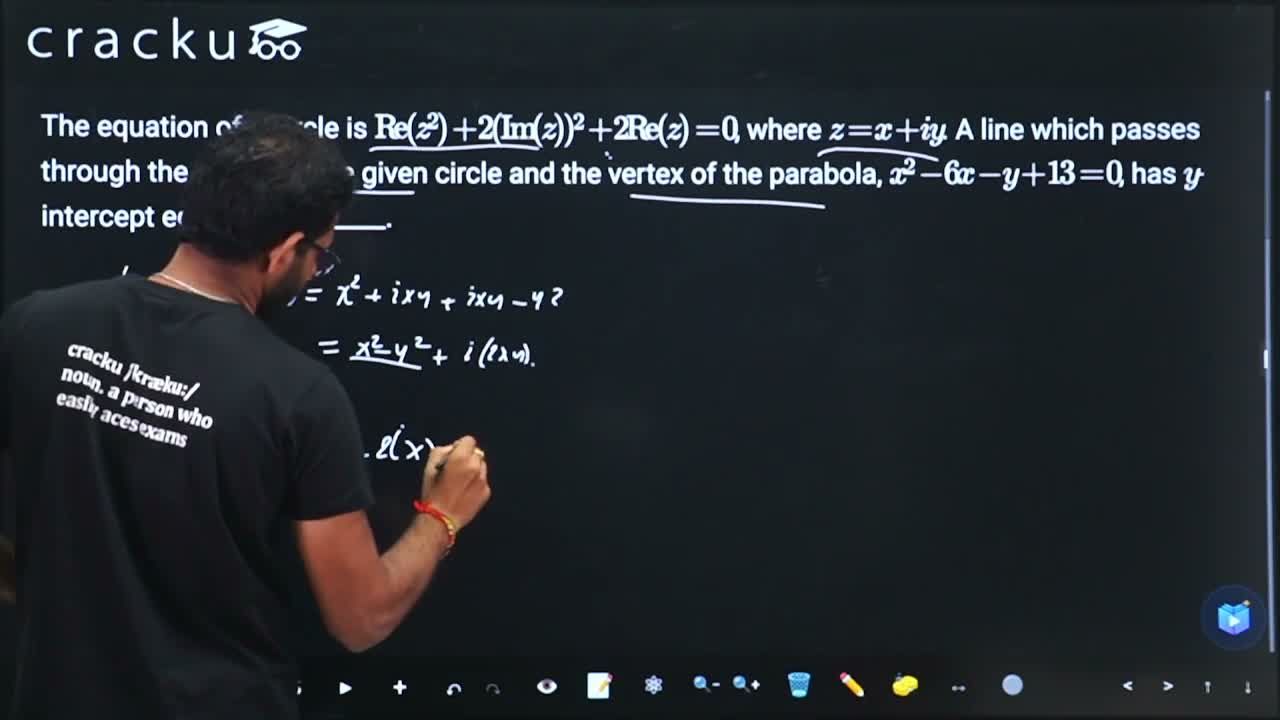
The equation of a circle is $$\text{Re}(z^2) + 2(\text{Im}(z))^2 + 2\text{Re}(z) = 0$$, where $$z = x + iy$$. A line which passes through the centre of the given circle and the vertex of the parabola, $$x^2 - 6x - y + 13 = 0$$, has $$y$$-intercept equal to _________.
Correct Answer: 1
Let us begin by translating the given complex-number condition into an equation in the real variables $$x$$ and $$y$$.
We write $$z=x+iy$$, so that
$$z^{2}=(x+iy)^{2}=x^{2}-y^{2}+2ixy.$$
The real part of $$z^{2}$$ is therefore
$$\text{Re}(z^{2})=x^{2}-y^{2}.$$
Also, by definition, $$\text{Im}(z)=y,$$ whence
$$(\text{Im}(z))^{2}=y^{2}.$$
The given equation of the circle is
$$\text{Re}(z^{2})+2(\text{Im}(z))^{2}+2\text{Re}(z)=0.$$
Substituting the expressions we have just obtained, we get
$$\bigl(x^{2}-y^{2}\bigr)+2y^{2}+2x=0.$$
Combining like terms in $$y^{2}$$ leads to
$$x^{2}-y^{2}+2y^{2}+2x=0 \;\Longrightarrow\; x^{2}+y^{2}+2x=0.$$
To recognise the centre and radius of the circle, we complete the square in $$x$$:
$$x^{2}+2x=(x+1)^{2}-1.$$
Hence the equation becomes
$$(x+1)^{2}-1+y^{2}=0 \;\Longrightarrow\; (x+1)^{2}+y^{2}=1.$$
We now see that the circle has centre $$(-1,0)$$ and radius $$1$$.
Next, consider the parabola whose equation is
$$x^{2}-6x-y+13=0.$$
We rewrite it in the more familiar form $$y=x^{2}-6x+13.$$ For a quadratic $$y=ax^{2}+bx+c,$$ the vertex has $$x\text{-coordinate}=-\dfrac{b}{2a}.$$
Here $$a=1$$ and $$b=-6,$$ so
$$x_{v}=-\dfrac{-6}{2\cdot1}=3.$$
Substituting $$x=3$$ back into the expression for $$y$$ gives
$$y_{v}=3^{2}-6\cdot3+13=9-18+13=4.$$
Thus, the vertex of the parabola is $$\bigl(3,4\bigr).$$
We now require the straight line that passes through the two points $$(-1,0)$$ (the circle’s centre) and $$\bigl(3,4\bigr)$$ (the parabola’s vertex).
The slope (gradient) of a line through $$(x_{1},y_{1})$$ and $$(x_{2},y_{2})$$ is given by the formula $$m=\dfrac{y_{2}-y_{1}}{x_{2}-x_{1}}.$$
Applying this formula, we have
$$m=\dfrac{4-0}{3-(-1)}=\dfrac{4}{4}=1.$$
With slope $$m=1$$ and passing through, say, the point $$(3,4),$$ the point-slope form $$y-y_{1}=m(x-x_{1})$$ yields
$$y-4=1\bigl(x-3\bigr).$$
Simplifying, we find the equation of the line:
$$y=x+1.$$
The $$y$$-intercept of a line is its $$y$$-value when $$x=0.$$ Setting $$x=0$$ above gives
$$y=0+1=1.$$
Therefore, the required $$y$$-intercept equals $$1.$$
So, the answer is $$1$$.
Was this solution helpful?
Click on the Email ☝️ to Watch the Video Solution
Create a FREE account and get:
_1.webp)

Educational materials for JEE preparation

Ask our AI anything

AI can make mistakes. Please verify important information.
AI can make mistakes. Please verify important information.
