
Join Our JEE Preparation Group
Prep with like-minded aspirants; Get access to free daily tests and study material.
Sign in
Please select an account to continue using cracku.in
↓ →
Join Our JEE Preparation Group
Prep with like-minded aspirants; Get access to free daily tests and study material.
Let the positive integers be written in the form:
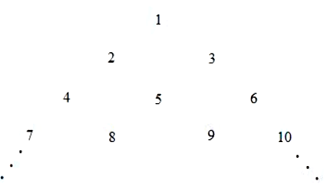
If the $$k^{th}$$ row contains exactly $$k$$ numbers for every natural number $$k$$, then the row in which the number 5310 will be, is ________
Correct Answer: 103
Notice the pattern of the last number in each row:
The last number in the $$k^{th}$$ row is simply the sum of the number of elements in the first $$k$$ rows. Using the standard summation formula for the first $$k$$ natural numbers, the last term of the $$k^{th}$$ row is:
$$L_k = \frac{k(k+1)}{2}$$
We need to find the row $$k$$ that contains the number $$5310$$. This means $$5310$$ must be strictly greater than the last number of the $$(k-1)^{th}$$ row and less than or equal to the last number of the $$k^{th}$$ row:
$$\frac{(k-1)k}{2} < 5310 \le \frac{k(k+1)}{2}$$
To find an approximate value for $$k$$, let's simplify the inequality to rough squares:
$$\frac{k^2}{2} \approx 5310 \implies k^2 \approx 10620$$
We know that $$100^2 = 10000$$, so $$k$$ must be slightly larger than $$100$$.
Let's test a couple of nearby values for the exact row endings:
Since $$5253 < 5310 \le 5356$$, the number $$5310$$ appears after the 102nd row has ended, placing it securely inside the 103rd row.
The row is $$103$$.
Was this solution helpful?
Click on the Email ☝️ to Watch the Video Solution
Create a FREE account and get:
_1.webp)

Educational materials for JEE preparation

Ask our AI anything

AI can make mistakes. Please verify important information.
AI can make mistakes. Please verify important information.
