
Join Our JEE Preparation Group
Prep with like-minded aspirants; Get access to free daily tests and study material.
Sign in
Please select an account to continue using cracku.in
↓ →
Join Our JEE Preparation Group
Prep with like-minded aspirants; Get access to free daily tests and study material.
Let $$b_1b_2b_3b_4$$ be a 4-element permutation with $$b_i \in \{1, 2, 3, \ldots, 100\}$$ for $$1 \leq i \leq 4$$ and $$b_i \neq b_j$$ for $$i \neq j$$, such that either $$b_1, b_2, b_3$$ are consecutive integers or $$b_2, b_3, b_4$$ are consecutive integers. Then the number of such permutations $$b_1b_2b_3b_4$$ is equal to ______.
Correct Answer: 18915
We need to count 4-element permutations $$b_1b_2b_3b_4$$ with $$b_i \in \{1,2,\ldots,100\}$$, all distinct, such that either $$b_1, b_2, b_3$$ are consecutive integers or $$b_2, b_3, b_4$$ are consecutive integers. Here "consecutive integers" means they appear in increasing consecutive order.
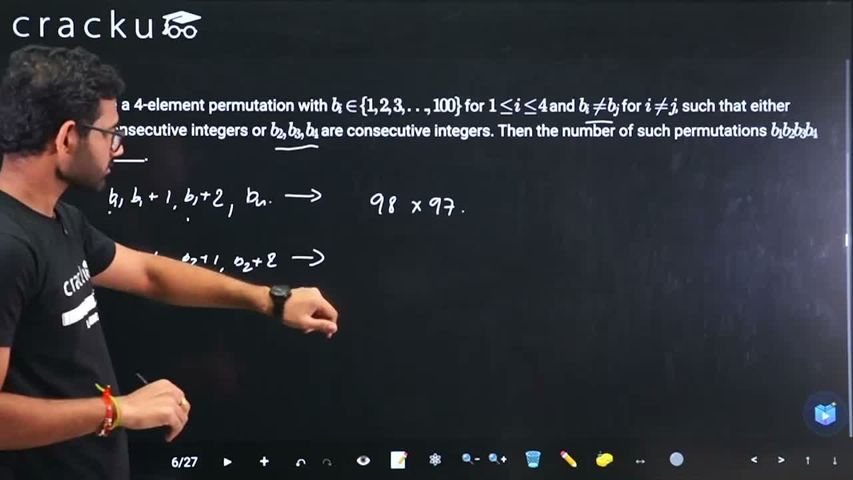
For permutations where $$b_1, b_2, b_3$$ are consecutive, we require $$b_2 = b_1 + 1$$ and $$b_3 = b_1 + 2$$. The starting value $$b_1$$ can be any integer from 1 to 98, giving 98 choices, and the fourth element $$b_4$$ can be any of the remaining $$100 - 3 = 97$$ values. Thus $$|A| = 98 \times 97 = 9506$$.
Similarly, for permutations where $$b_2, b_3, b_4$$ are consecutive, we require $$b_3 = b_2 + 1$$ and $$b_4 = b_2 + 2$$. The starting value $$b_2$$ can be any integer from 1 to 98, giving 98 choices, and the first element $$b_1$$ can be any of the remaining $$100 - 3 = 97$$ values. Hence $$|B| = 98 \times 97 = 9506$$.
In the overlap where both conditions hold, we have from the first condition $$b_2 = b_1 + 1$$, $$b_3 = b_1 + 2$$ and from the second condition $$b_3 = b_2 + 1 = b_1 + 2$$ and $$b_4 = b_2 + 2 = b_1 + 3$$. Therefore all four elements are consecutive: $$b_1, b_1+1, b_1+2, b_1+3$$, with the starting value $$b_1$$ ranging from 1 to 97, giving $$|A \cap B| = 97$$.
By inclusion-exclusion, $$|A \cup B| = |A| + |B| - |A \cap B| = 9506 + 9506 - 97 = 18915$$.
The answer is $$\boxed{18915}$$.
Was this solution helpful?
Click on the Email ☝️ to Watch the Video Solution
Create a FREE account and get:
_1.webp)

Educational materials for JEE preparation

Ask our AI anything

AI can make mistakes. Please verify important information.
AI can make mistakes. Please verify important information.
