
Join Our JEE Preparation Group
Prep with like-minded aspirants; Get access to free daily tests and study material.
Sign in
Please select an account to continue using cracku.in
↓ →
Join Our JEE Preparation Group
Prep with like-minded aspirants; Get access to free daily tests and study material.
If $$S(x) = (1+x) + 2(1+x)^2 + 3(1+x)^3 + \cdots + 60(1+x)^{60}$$, $$x \neq 0$$, and $$(60)^2 S(60) = a(b)^b + b$$, where $$a, b \in N$$, then $$(a + b)$$ equal to ___________
Correct Answer: 3660
The given series is an Arithmetico-Geometric Progression (AGP) where the arithmetic terms are $$1, 2, 3, \dots, 60$$ and the geometric terms are $$(1+x), (1+x)^2, \dots, (1+x)^{60}$$. Let the common ratio of the geometric part be $$r = (1+x)$$.
Let's write out the sum $$S(x)$$ and then write it again, multiplied by the common ratio $$(1+x)$$, shifted one term to the right:
$$S(x) = 1(1+x) + 2(1+x)^2 + 3(1+x)^3 + \dots + 60(1+x)^{60}$$
$$(1+x)S(x) = \phantom{1(1+x) + } 1(1+x)^2 + 2(1+x)^3 + \dots + 59(1+x)^{60} + 60(1+x)^{61}$$
Now, subtract the second equation from the first:
$$S(x) - (1+x)S(x) = (1+x) + [1(1+x)^2 + 1(1+x)^3 + \dots + 1(1+x)^{60}] - 60(1+x)^{61}$$
$$-x S(x) = [(1+x) + (1+x)^2 + (1+x)^3 + \dots + (1+x)^{60}] - 60(1+x)^{61}$$
The terms inside the square brackets now form a standard Geometric Progression (GP) with the first term $$a = (1+x)$$, common ratio $$r = (1+x)$$, and number of terms $$n = 60$$.
Apply the standard GP sum formula, $$S_n = a \left( \frac{r^n - 1}{r - 1} \right)$$:
$$-x S(x) = (1+x) \left[ \frac{(1+x)^{60} - 1}{(1+x) - 1} \right] - 60(1+x)^{61}$$
$$-x S(x) = \frac{(1+x)^{61} - (1+x)}{x} - 60(1+x)^{61}$$
Divide the entire equation by $$-x$$ to isolate $$S(x)$$:
$$S(x) = 60 \frac{(1+x)^{61}}{x} - \frac{(1+x)^{61} - (1+x)}{x^2}$$
We are given the expression $$(60)^2 S(60)$$.
Let's substitute $$x = 60$$ into our derived formula (note that $$1+x = 61$$):
$$S(60) = 60 \frac{(61)^{61}}{60} - \frac{61^{61} - 61}{60^2}$$
$$S(60) = 61^{61} - \frac{61^{61} - 61}{60^2}$$
Now, multiply the entire expression by $$60^2$$:
$$(60)^2 S(60) = 60^2(61^{61}) - (61^{61} - 61)$$
$$(60)^2 S(60) = 3600(61^{61}) - 61^{61} + 61$$
$$(60)^2 S(60) = 3599(61)^{61} + 61$$
We are given that this must equal $$a(b)^b + b$$. Comparing the two expressions, the pattern matches perfectly:
Finally, calculate the required value:
$$(a + b) = 3599 + 61 = 3660$$
Was this solution helpful?
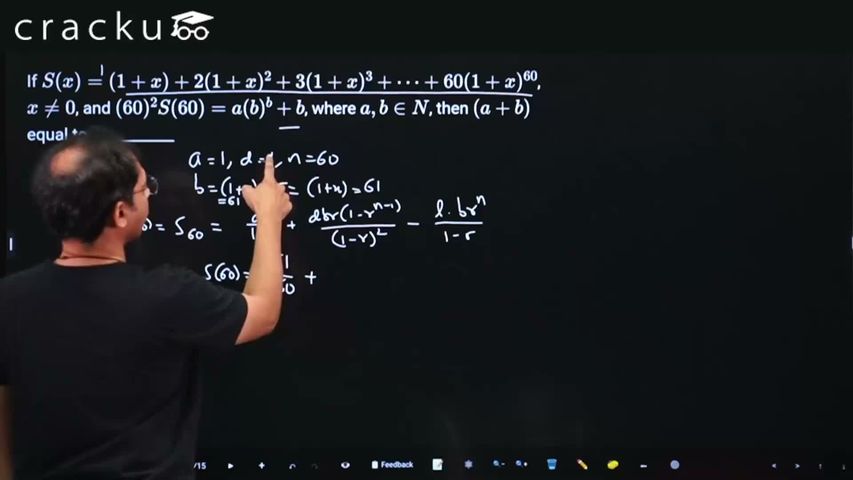
Click on the Email ☝️ to Watch the Video Solution
Create a FREE account and get:
_1.webp)

Educational materials for JEE preparation

Ask our AI anything

AI can make mistakes. Please verify important information.
AI can make mistakes. Please verify important information.
