
Join Our JEE Preparation Group
Prep with like-minded aspirants; Get access to free daily tests and study material.
Sign in
Please select an account to continue using cracku.in
↓ →
Join Our JEE Preparation Group
Prep with like-minded aspirants; Get access to free daily tests and study material.
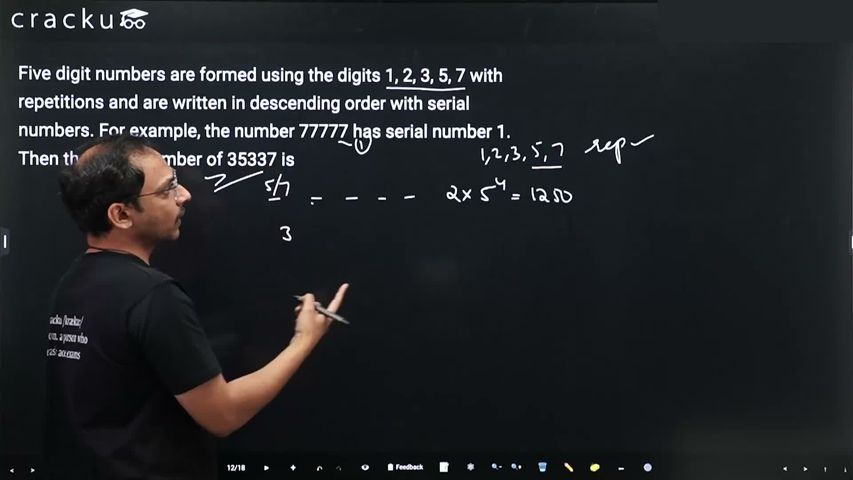
Five digit numbers are formed using the digits 1, 2, 3, 5, 7 with repetitions and are written in descending order with serial numbers. For example, the number 77777 has serial number 1. Then the serial number of 35337 is
Correct Answer: 1436
Five-digit numbers formed using digits $$\{1, 2, 3, 5, 7\}$$ with repetitions are arranged in descending order, and we wish to find the position of 35337 in this list. Since the available digits in decreasing order are $$7, 5, 3, 2, 1$$, we first count how many numbers exceed 35337.
Numbers starting with 7 or 5 (first digit $$> 3$$): since there are 2 choices for the first digit and each of the remaining four digits can be any of the five available, we have $$2 \times 5^4 = 2 \times 625 = 1250$$ such numbers.
Next, numbers with first digit 3 and second digit $$> 5$$ (i.e., 7) give $$1 \times 5^3 = 125$$.
Then, numbers with first two digits 35 and third digit $$> 3$$ (i.e., 5 or 7) yield $$2 \times 5^2 = 50$$.
Subsequently, numbers with first three digits 353 and fourth digit $$> 3$$ (i.e., 5 or 7) yield $$2 \times 5 = 10$$.
Furthermore, numbers with first four digits 3533 and fifth digit $$> 7$$ contribute 0 since no digit exceeds 7.
From the above, therefore the serial number of 35337 is given by adding these counts plus 1 for the number itself:
$$1250 + 125 + 50 + 10 + 0 + 1 = 1436$$.
Hence, the serial number of 35337 is 1436.
Was this solution helpful?
Click on the Email ☝️ to Watch the Video Solution
Create a FREE account and get:
_1.webp)

Educational materials for JEE preparation

Ask our AI anything

AI can make mistakes. Please verify important information.
AI can make mistakes. Please verify important information.
