
Join Our JEE Preparation Group
Prep with like-minded aspirants; Get access to free daily tests and study material.
Sign in
Please select an account to continue using cracku.in
↓ →
Join Our JEE Preparation Group
Prep with like-minded aspirants; Get access to free daily tests and study material.
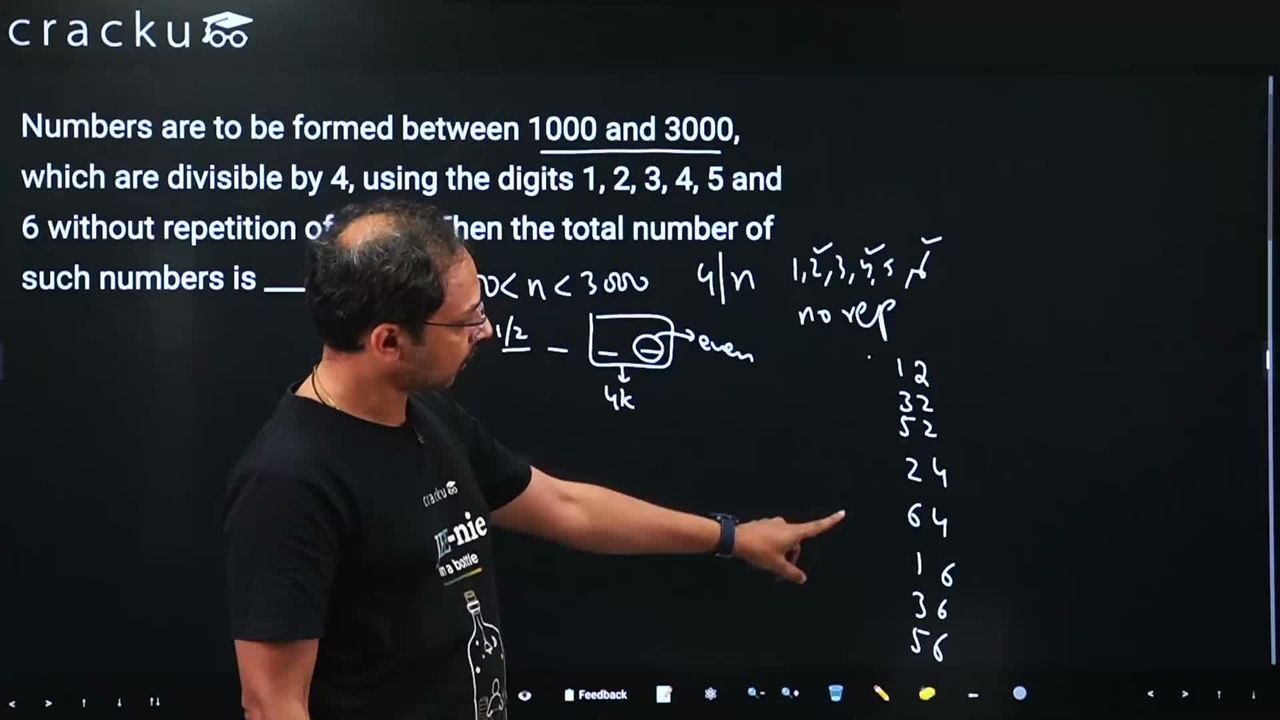
Numbers are to be formed between 1000 and 3000, which are divisible by 4, using the digits 1, 2, 3, 4, 5 and 6 without repetition of digits. Then the total number of such numbers is ______.
Correct Answer: 30
We need to find how many 4-digit numbers between 1000 and 3000, divisible by 4, can be formed using digits 1, 2, 3, 4, 5, 6 without repetition.
Since the number is between 1000 and 3000, the first digit is either 1 or 2.
A number is divisible by 4 if its last two digits form a number divisible by 4. The possible two-digit endings from {1, 2, 3, 4, 5, 6} (without repetition between the two digits) that are divisible by 4 are:
12, 16, 24, 32, 36, 52, 56, 64
Remaining digits available: {2, 3, 4, 5, 6} (digit 1 is used).
Valid endings not using digit 1: 24, 32, 36, 52, 56, 64 — that gives 6 endings.
For each ending, the second digit can be any of the remaining 3 digits (from the 5 available, minus the 2 used in the ending).
Count: $$6 \times 3 = 18$$
Remaining digits available: {1, 3, 4, 5, 6} (digit 2 is used).
Valid endings not using digit 2: 16, 36, 56, 64 — that gives 4 endings.
(Endings 12, 24, 32, 52 all use digit 2, so they are excluded.)
For each ending, the second digit can be any of the remaining 3 digits.
Count: $$4 \times 3 = 12$$
$$18 + 12 = 30$$
The correct answer is $$\boxed{30}$$.
Was this solution helpful?
Click on the Email ☝️ to Watch the Video Solution
Create a FREE account and get:
_1.webp)

Educational materials for JEE preparation

Ask our AI anything

AI can make mistakes. Please verify important information.
AI can make mistakes. Please verify important information.
