
Join Our JEE Preparation Group
Prep with like-minded aspirants; Get access to free daily tests and study material.
Sign in
Please select an account to continue using cracku.in
↓ →
Join Our JEE Preparation Group
Prep with like-minded aspirants; Get access to free daily tests and study material.
Let $$X$$ be a random variable such that the probability function of a distribution is given by $$P(X = 0) = \frac{1}{2}$$, $$P(X = j) = \frac{1}{3^j}$$ $$(j = 1, 2, 3, \ldots, \infty)$$. Then the mean of the distribution and $$P(X$$ is positive and even) respectively, are:
We have a discrete random variable $$X$$ whose probability mass function is given as follows:
$$P(X = 0) = \frac{1}{2}, \qquad P(X = j) = \frac{1}{3^{\,j}} \; \text{for} \; j = 1,2,3,\ldots$$
First we verify that the total probability is $$1$$. For the strictly positive values we must sum the geometric series
$$\sum_{j = 1}^{\infty} \frac{1}{3^{\,j}}.$$
We recall the infinite geometric‐series formula: if $$|r| < 1$$, then
$$\sum_{j = 1}^{\infty} r^{\,j} \;=\; \frac{r}{1 - r}.$$
Here $$r = \dfrac13$$, so
$$\sum_{j = 1}^{\infty} \frac1{3^{\,j}} = \frac{\tfrac13}{1 - \tfrac13} = \frac{\tfrac13}{\tfrac23} = \frac{1}{2}.$$
Adding the probability at $$j = 0$$ gives
$$P(X=0) + \sum_{j=1}^{\infty} P(X=j) = \frac12 + \frac12 = 1,$$
so the distribution is valid.
Now we find the mean (expected value) $$E[X]$$. By definition, for a discrete variable,
$$E[X] \;=\; \sum_{x} x\,P(X=x).$$
Because the term at $$x=0$$ contributes nothing, we have
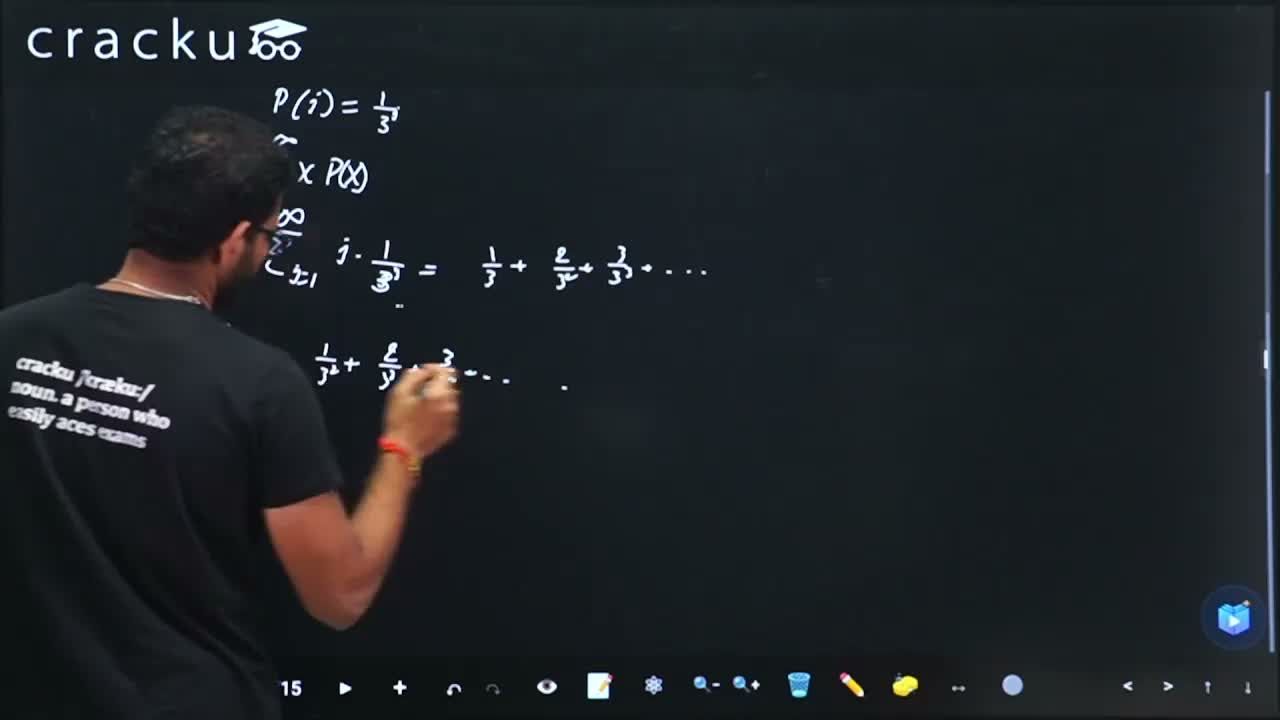
$$E[X] = \sum_{j = 1}^{\infty} j \,\frac1{3^{\,j}}.$$
Again we use a standard result for an infinite geometric‐like sum. For $$|r| < 1$$,
$$\sum_{j = 1}^{\infty} j\,r^{\,j} \;=\; \frac{r}{(1 - r)^{2}}.$$
Setting $$r = \dfrac13$$ gives
$$E[X] = \frac{\tfrac13}{(1 - \tfrac13)^{2}} = \frac{\tfrac13}{\left(\tfrac23\right)^{2}} = \frac{\tfrac13}{\tfrac49} = \tfrac13 \times \tfrac94 = \frac34.$$
Next we need the probability that $$X$$ is both positive and even. Let us write the positive even values as $$2,4,6,\ldots$$, that is $$X = 2k$$ where $$k = 1,2,3,\ldots$$. Therefore
$$P(X \text{ is positive and even}) = \sum_{k = 1}^{\infty} P(X = 2k) = \sum_{k = 1}^{\infty} \frac1{3^{\,2k}} = \sum_{k = 1}^{\infty} \left(\frac1{3^{2}}\right)^{k} = \sum_{k = 1}^{\infty} \left(\frac1{9}\right)^{k}.$$
This is another geometric series with common ratio $$\dfrac19$$. Using the same formula for the sum, we get
$$\sum_{k = 1}^{\infty} \left(\frac19\right)^{k} = \frac{\tfrac19}{1 - \tfrac19} = \frac{\tfrac19}{\tfrac89} = \frac{1}{8}.$$
We have now obtained both required quantities: the mean $$E[X] = \dfrac34$$ and the probability that $$X$$ is positive and even $$= \dfrac18$$.
Hence, the correct answer is Option B.
Was this solution helpful?
Click on the Email ☝️ to Watch the Video Solution
Create a FREE account and get:
_1.webp)

Educational materials for JEE preparation

Ask our AI anything

AI can make mistakes. Please verify important information.
AI can make mistakes. Please verify important information.
