
Join Our JEE Preparation Group
Prep with like-minded aspirants; Get access to free daily tests and study material.
Sign in
Please select an account to continue using cracku.in
↓ →
Join Our JEE Preparation Group
Prep with like-minded aspirants; Get access to free daily tests and study material.
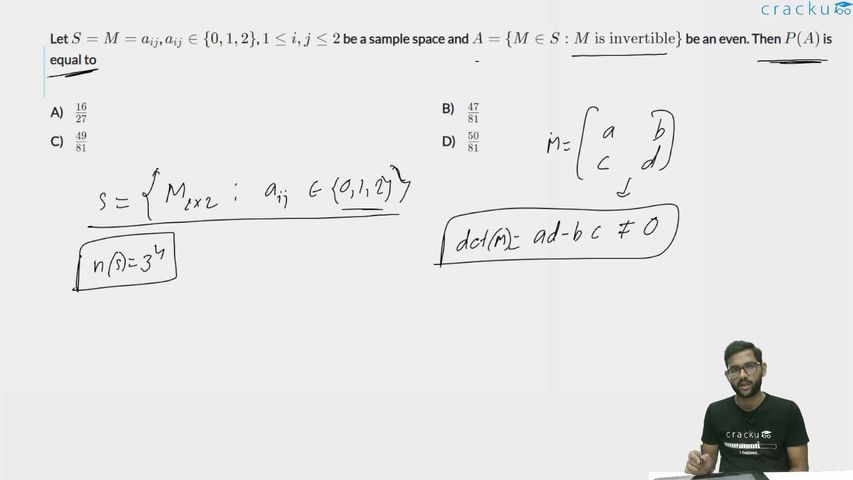
Let $$S = M = a_{ij}$$, $$a_{ij} \in \{0, 1, 2\}$$, $$1 \leq i, j \leq 2$$ be a sample space and $$A = \{M \in S: M \text{ is invertible}\}$$ be an even. Then $$P(A)$$ is equal to
We need to find the probability that a randomly chosen 2x2 matrix with entries from $$\{0, 1, 2\}$$ is invertible.
Determine the sample space.
A 2x2 matrix $$M = \begin{pmatrix} a & b \\ c & d \end{pmatrix}$$ has 4 entries, each chosen from $$\{0, 1, 2\}$$. Total number of matrices = $$3^4 = 81$$.
Determine the condition for invertibility.
A 2x2 matrix is invertible if and only if its determinant is non-zero:
$$ \det(M) = ad - bc \neq 0 $$
So we need to count matrices where $$ad = bc$$ (non-invertible), then subtract from 81.
Count the number of ways each product value can occur.
For two numbers chosen from $$\{0, 1, 2\}$$, the possible products and the number of ordered pairs $$(x, y)$$ giving each product are:
- Product = 0: pairs where at least one is 0. These are: $$(0,0), (0,1), (0,2), (1,0), (2,0)$$ = 5 ways
- Product = 1: $$(1,1)$$ = 1 way
- Product = 2: $$(1,2), (2,1)$$ = 2 ways
- Product = 4: $$(2,2)$$ = 1 way
Verification: $$5 + 1 + 2 + 1 = 9 = 3^2$$ .
Count matrices with $$ad = bc$$ (determinant = 0).
For $$ad = bc$$, both products must equal the same value. The number of such matrices is:
$$ N(\det = 0) = 5 \times 5 + 1 \times 1 + 2 \times 2 + 1 \times 1 $$
$$ = 25 + 1 + 4 + 1 = 31 $$
Here, for each possible product value $$p$$, we multiply the number of ways to get $$ad = p$$ by the number of ways to get $$bc = p$$.
Calculate the number of invertible matrices and the probability.
Number of invertible matrices = $$81 - 31 = 50$$
$$ P(A) = \frac{50}{81} $$
The correct answer is Option 4: $$\dfrac{50}{81}$$.
Was this solution helpful?
Click on the Email ☝️ to Watch the Video Solution
Create a FREE account and get:
_1.webp)

Educational materials for JEE preparation

Ask our AI anything

AI can make mistakes. Please verify important information.
AI can make mistakes. Please verify important information.
