
Join Our JEE Preparation Group
Prep with like-minded aspirants; Get access to free daily tests and study material.
Sign in
Please select an account to continue using cracku.in
↓ →
Join Our JEE Preparation Group
Prep with like-minded aspirants; Get access to free daily tests and study material.
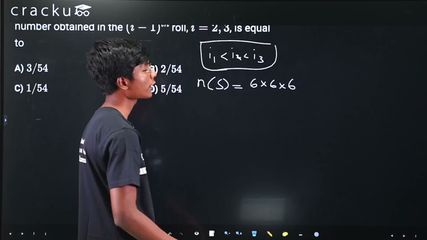
If an unbiased dice is rolled thrice, then the probability of getting a greater number in the $$i^{th}$$ roll than the number obtained in the $$(i-1)^{th}$$ roll, $$i = 2, 3$$, is equal to
We are looking for the probability that the three rolls $$(x_1, x_2, x_3)$$ satisfy the condition $$x_1 < x_2 < x_3$$.
Total Outcomes: Since a die has 6 faces and is rolled 3 times, total outcomes = $$6 \times 6 \times 6 = 216$$.
Favourable Outcomes: We need to choose 3 distinct numbers from the set $$\{1, 2, 3, 4, 5, 6\}$$. Once 3 distinct numbers are chosen, there is only one way to arrange them in strictly increasing order.
Number of ways to choose 3 numbers = $$\binom{6}{3} = \frac{6 \times 5 \times 4}{3 \times 2 \times 1} = 20$$.
Probability:
$$P = \frac{20}{216}$$
Dividing both by 4:
$$P = \frac{5}{54}$$
Was this solution helpful?
Click on the Email ☝️ to Watch the Video Solution
Create a FREE account and get:
_1.webp)

Educational materials for JEE preparation

Ask our AI anything

AI can make mistakes. Please verify important information.
AI can make mistakes. Please verify important information.
