
Join Our JEE Preparation Group
Prep with like-minded aspirants; Get access to free daily tests and study material.
Sign in
Please select an account to continue using cracku.in
↓ →
Join Our JEE Preparation Group
Prep with like-minded aspirants; Get access to free daily tests and study material.
Consider the line $$L$$ passing through the points $$(1, 2, 3)$$ and $$(2, 3, 5)$$. The distance of the point $$\left(\frac{11}{3}, \frac{11}{3}, \frac{19}{3}\right)$$ from the line $$L$$ along the line $$\frac{3x-11}{2} = \frac{3y-11}{1} = \frac{3z-19}{2}$$ is equal to
Line $$L$$ passes through $$(1,2,3)$$ and $$(2,3,5)$$, and the problem asks for the distance of $$P\left(\frac{11}{3},\frac{11}{3},\frac{19}{3}\right)$$ from $$L$$ along the line $$\frac{3x-11}{2}=\frac{3y-11}{1}=\frac{3z-19}{2}$$.
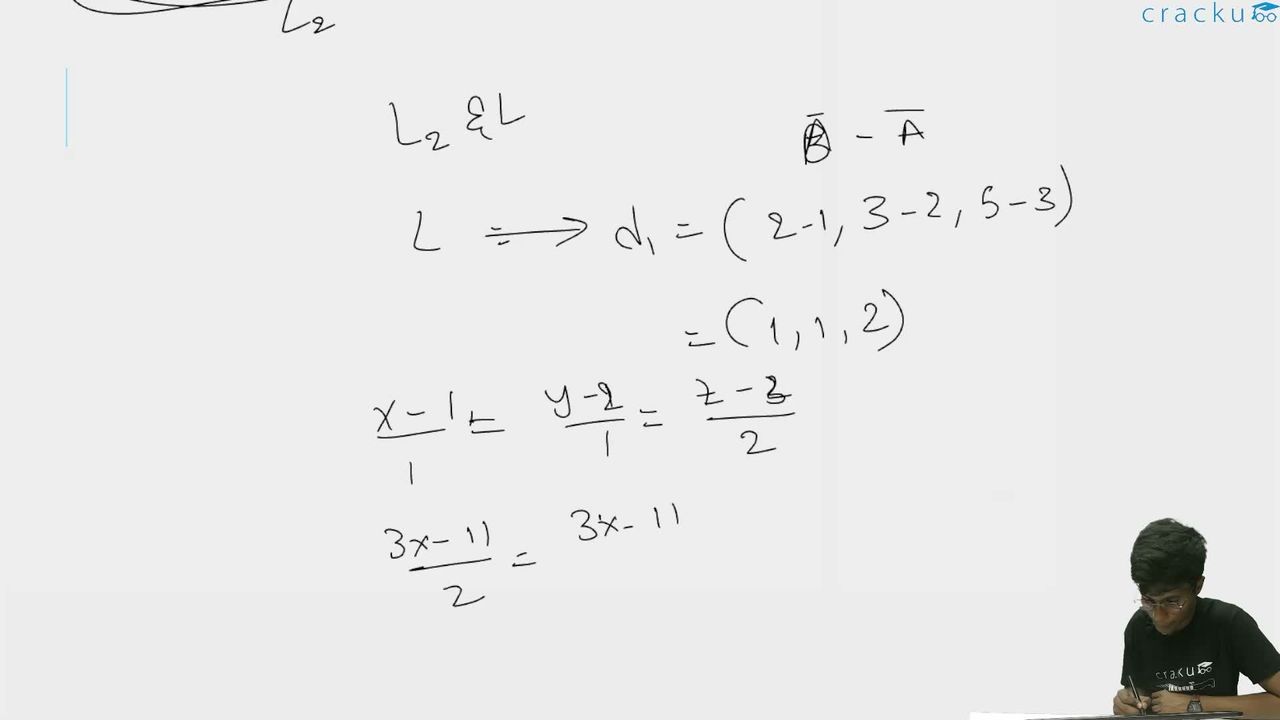
Since $$L$$ passes through these two points, its direction vector is $$(2-1,3-2,5-3)=(1,1,2)$$, so that $$L:\frac{x-1}{1}=\frac{y-2}{1}=\frac{z-3}{2}=\lambda$$.
Next, the line $$\frac{3x-11}{2}=\frac{3y-11}{1}=\frac{3z-19}{2}$$ passes through $$P\left(\frac{11}{3},\frac{11}{3},\frac{19}{3}\right)$$ with direction vector $$(2,1,2)$$, which leads to the parametric form $$\left(\frac{11}{3}+\frac{2t}{3},\frac{11}{3}+\frac{t}{3},\frac{19}{3}+\frac{2t}{3}\right)$$.
For this point to lie on $$L$$, the relations $$\frac{\left(\frac{11}{3}+\frac{2t}{3}\right)-1}{1}=\frac{\left(\frac{11}{3}+\frac{t}{3}\right)-2}{1}$$ yield $$\frac{8+2t}{3}=\frac{5+t}{3}$$, which leads to $$8+2t=5+t$$, so that $$t=-3$$.
Substituting $$t=-3$$ gives the intersection point $$\left(\frac{11}{3}-2,\frac{11}{3}-1,\frac{19}{3}-2\right)=\left(\frac{5}{3},\frac{8}{3},\frac{13}{3}\right)$$, and verifying on $$L$$ shows $$\frac{5/3-1}{1}=\frac{8/3-2}{1}=\frac{13/3-3}{2}=\frac{2}{3}$$.
Then the displacement from $$P$$ to the intersection point corresponds to $$t=-3$$ along the direction vector $$\left(\frac{2}{3},\frac{1}{3},\frac{2}{3}\right)$$, so $$d=\sqrt{\left(\frac{2(-3)}{3}\right)^2+\left(\frac{-3}{3}\right)^2+\left(\frac{2(-3)}{3}\right)^2}=\sqrt{4+1+4}=\sqrt{9}=3$$.
The distance is 3.
The correct answer is Option (4): 3.
Was this solution helpful?
Click on the Email ☝️ to Watch the Video Solution
Create a FREE account and get:
_1.webp)

Educational materials for JEE preparation

Ask our AI anything

AI can make mistakes. Please verify important information.
AI can make mistakes. Please verify important information.
