
Join Our JEE Preparation Group
Prep with like-minded aspirants; Get access to free daily tests and study material.
Sign in
Please select an account to continue using cracku.in
↓ →
Join Our JEE Preparation Group
Prep with like-minded aspirants; Get access to free daily tests and study material.
A six faced die is biased such that $$3 \times P(\text{a prime number}) = 6 \times P(\text{a composite number}) = 2 \times P(1)$$. Let X be a random variable that counts the number of times one gets a perfect square on some throws of this die. If the die is thrown twice, then the mean of X is
A die has faces {1, 2, 3, 4, 5, 6}. The primes are {2, 3, 5}, the composites are {4, 6}, and {1} is neither.
Let $$P(\text{each prime face}) = p$$, $$P(\text{each composite face}) = q$$, and $$P(1) = r$$.
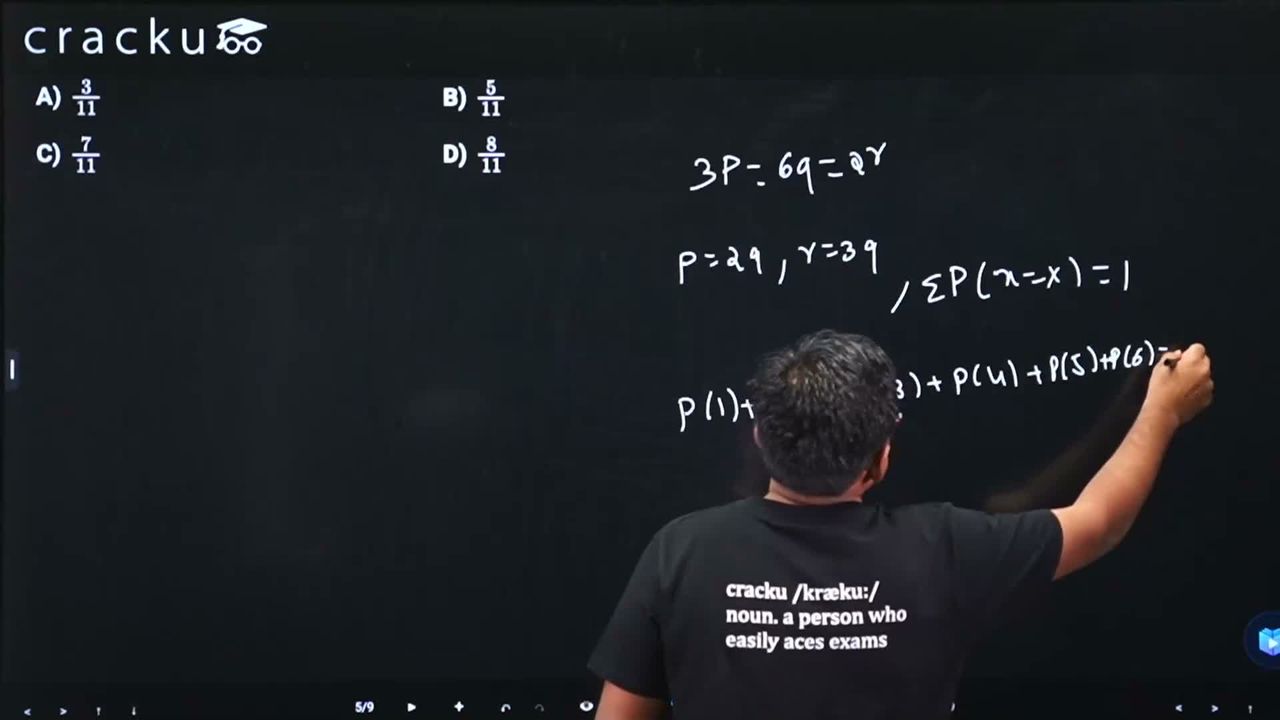
The given condition is: $$3p = 6q = 2r$$.
Here $$3 \times P(\text{a prime number})$$ means $$3$$ times the probability of getting any one specific prime. Since each prime face has probability $$p$$, we interpret the condition as $$3p = 6q = 2r$$.
From $$3p = 6q$$: $$p = 2q$$.
From $$6q = 2r$$: $$r = 3q$$.
Total probability must equal 1:
$$3p + 2q + r = 1$$
$$3(2q) + 2q + 3q = 1$$
$$6q + 2q + 3q = 1$$
$$11q = 1 \implies q = \frac{1}{11}$$
Therefore: $$p = \frac{2}{11}$$, $$q = \frac{1}{11}$$, $$r = \frac{3}{11}$$.
Perfect squares on a die: {1, 4}.
$$P(\text{perfect square}) = P(1) + P(4) = \frac{3}{11} + \frac{1}{11} = \frac{4}{11}$$
X counts perfect squares in 2 throws, so $$X \sim \text{Binomial}\left(2, \frac{4}{11}\right)$$.
$$E(X) = np = 2 \times \frac{4}{11} = \frac{8}{11}$$
The correct answer is Option D: $$\frac{8}{11}$$.
Was this solution helpful?
Click on the Email ☝️ to Watch the Video Solution
Create a FREE account and get:
_1.webp)

Educational materials for JEE preparation

Ask our AI anything

AI can make mistakes. Please verify important information.
AI can make mistakes. Please verify important information.
