
Join Our JEE Preparation Group
Prep with like-minded aspirants; Get access to free daily tests and study material.
Sign in
Please select an account to continue using cracku.in
↓ →
Join Our JEE Preparation Group
Prep with like-minded aspirants; Get access to free daily tests and study material.
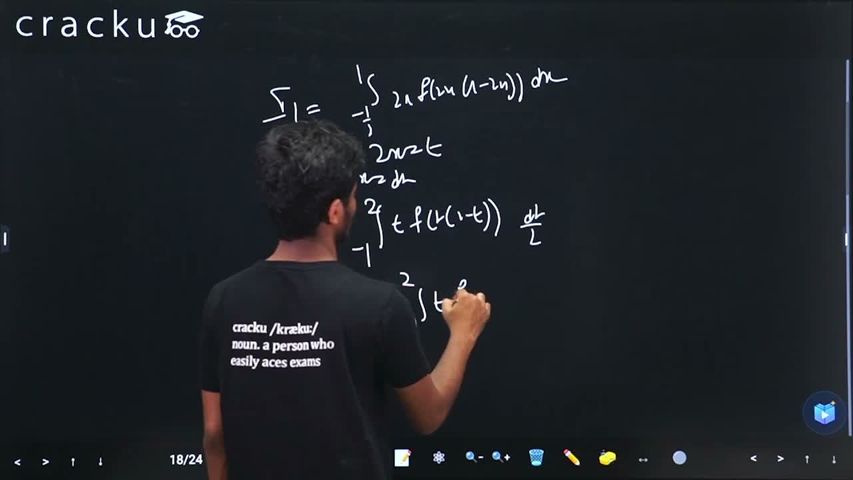
Let f(x) be a positive function and $$I_1 = \int_{-\frac{1}{2}}^{1} 2xf(2x(1-2x)) \, dx$$ and $$I_2 = \int_{-1}^{2} f(x(1-x)) \, dx$$. Then the value of $$\frac{I_2}{I_1}$$ is equal to :
Given
$$I_1 = \int_{-1/2}^{1} 2x\,f\!\left(2x\left(1-2x\right)\right)\,dx$$
$$I_2 = \int_{-1}^{2} f\!\left(x\left(1-x\right)\right)\,dx$$
Put $$x = 2t$$ in $$I_2$$. Then $$dx = 2\,dt$$, and the limits change as follows:
for $$x = -1$$, $$t = -\dfrac12$$; for $$x = 2$$, $$t = 1$$.
Hence
$$I_2 = \int_{-1}^{2} f\!\left(x(1-x)\right)\,dx = \int_{-1/2}^{1} f\!\left(2t(1-2t)\right)\,2\,dt = 2\int_{-1/2}^{1} f\!\left(2t(1-2t)\right)\,dt$$
For convenience, define
$$A = \int_{-1/2}^{1} f\!\left(2x(1-2x)\right)\,dx \qquad -(1)$$
With this notation we already have
$$I_2 = 2A \qquad -(2)$$
Next, relate $$I_1$$ to $$A$$. Write
$$I_1 = \int_{-1/2}^{1} 2x\,f\!\left(2x(1-2x)\right)\,dx$$
Let
$$J = \int_{-1/2}^{1} x\,f\!\left(2x(1-2x)\right)\,dx$$ so that $$I_1 = 2J$$.
The key symmetry is
$$g(x) = 2x(1-2x)$$ satisfies $$g\!\left(\dfrac12 - x\right)=g(x)$$.
Make the substitution $$u = \dfrac12 - x$$ in $$J$$. Then $$du = -dx$$ and the limits interchange, giving
$$J = \int_{-1/2}^{1} \left(\dfrac12 - u\right)\,f\!\left(g(u)\right)\,du$$
Add this result to the original definition of $$J$$:
$$2J = \int_{-1/2}^{1} \left[x + \left(\dfrac12 - x\right)\right] f\!\left(g(x)\right)\,dx = \int_{-1/2}^{1} \dfrac12\,f\!\left(g(x)\right)\,dx = \dfrac12\,A$$
Therefore
$$J = \dfrac14\,A \quad\Longrightarrow\quad I_1 = 2J = \dfrac12\,A \qquad -(3)$$
Combine $$(2)$$ and $$(3)$$:
$$\dfrac{I_2}{I_1} = \dfrac{2A}{A/2} = 4$$
Thus $$\displaystyle \frac{I_2}{I_1} = 4$$, corresponding to Option D.
Was this solution helpful?
Click on the Email ☝️ to Watch the Video Solution
Create a FREE account and get:
_1.webp)

Educational materials for JEE preparation

Ask our AI anything

AI can make mistakes. Please verify important information.
AI can make mistakes. Please verify important information.
