
Join Our JEE Preparation Group
Prep with like-minded aspirants; Get access to free daily tests and study material.
Sign in
Please select an account to continue using cracku.in
↓ →
Join Our JEE Preparation Group
Prep with like-minded aspirants; Get access to free daily tests and study material.
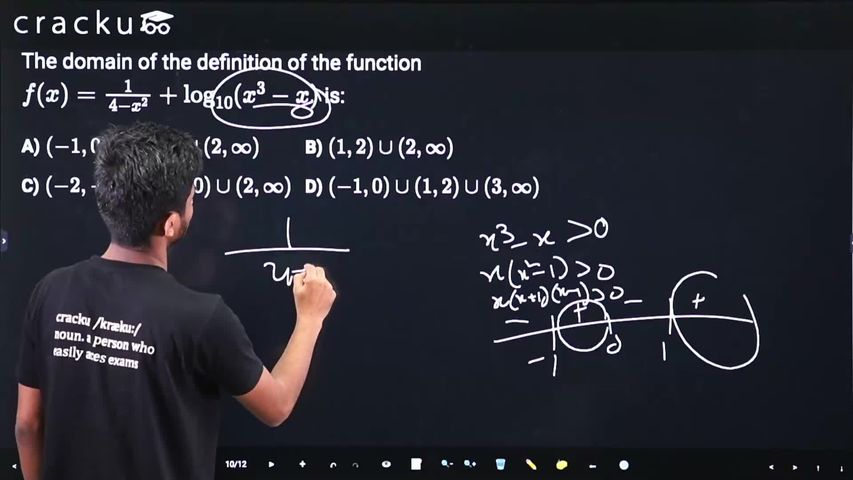
The domain of the definition of the function $$f(x) = \frac{1}{4 - x^2} + \log_{10}(x^3 - x)$$ is:
We have to find all real numbers $$x$$ for which the two separate parts of the given expression
$$f(x)=\dfrac{1}{4-x^{2}}+\log_{10}\!\bigl(x^{3}-x\bigr)$$
are simultaneously well-defined.
For the rational term $$\dfrac{1}{4-x^{2}}$$ the denominator must never be zero. We write
$$4-x^{2}\neq 0$$
$$\iff\;-x^{2}\neq -4$$
$$\iff\;x^{2}\neq 4$$
$$\iff\;x\neq \pm 2.$$
There is no further restriction here because a non-zero denominator may be positive or negative; we only exclude the points where it vanishes, namely $$x=-2$$ and $$x=2.$$
For the logarithmic term $$\log_{10}\!\bigl(x^{3}-x\bigr)$$ the argument of the logarithm must be strictly positive. Recalling the basic rule
“A real logarithm $$\log_{a}(y)$$ is defined only when $$y>0,$$”
we impose
$$x^{3}-x>0.$$
We factor the cubic completely:
$$x^{3}-x = x\bigl(x^{2}-1\bigr)$$
$$=x(x-1)(x+1).$$
So we need
$$x(x-1)(x+1)>0.$$
To solve this inequality we examine the sign of the product across the critical points $$x=-1,\;0,\;1.$$ We set up intervals and test each one.
1. Interval $$(-\infty,-1):$$ choose $$x=-2.$$
$$(-2)(-2-1)(-2+1)=(-2)(-3)(-1)=6\cdot(-1)=-6<0.$$
2. Interval $$(-1,0):$$ choose $$x=-\tfrac12.$$
$$\Bigl(-\tfrac12\Bigr)\Bigl(-\tfrac12-1\Bigr)\Bigl(-\tfrac12+1\Bigr) =\Bigl(-\tfrac12\Bigr)\Bigl(-\tfrac32\Bigr)\Bigl(\tfrac12\Bigr) =\tfrac34\cdot\tfrac12=\tfrac38>0.$$
3. Interval $$(0,1):$$ choose $$x=\tfrac12.$$
$$\Bigl(\tfrac12\Bigr)\Bigl(\tfrac12-1\Bigr)\Bigl(\tfrac12+1\Bigr) =\Bigl(\tfrac12\Bigr)\Bigl(-\tfrac12\Bigr)\Bigl(\tfrac32\Bigr) =-\tfrac14\cdot\tfrac32=-\tfrac38<0.$$
4. Interval $$(1,\infty):$$ choose $$x=2.$$
$$(2)(2-1)(2+1)=2\cdot1\cdot3=6>0.$$
The product is therefore positive on
$$(-1,0)\quad\text{and}\quad(1,\infty).$$
Combining both sets of conditions:
Subtracting the single forbidden point $$x=2$$ from $$(1,\infty)$$ splits that interval into two pieces:
$$(1,\infty)\setminus\{2\}=(1,2)\cup(2,\infty).$$
Putting everything together, the set of all admissible $$x$$ is
$$(-1,0)\;\cup\;(1,2)\;\cup\;(2,\infty).$$
This collection exactly matches Option A.
Hence, the correct answer is Option A.
Was this solution helpful?
Click on the Email ☝️ to Watch the Video Solution
Create a FREE account and get:
_1.webp)

Educational materials for JEE preparation

Ask our AI anything

AI can make mistakes. Please verify important information.
AI can make mistakes. Please verify important information.


