
Join Our JEE Preparation Group
Prep with like-minded aspirants; Get access to free daily tests and study material.
Sign in
Please select an account to continue using cracku.in
↓ →
Join Our JEE Preparation Group
Prep with like-minded aspirants; Get access to free daily tests and study material.
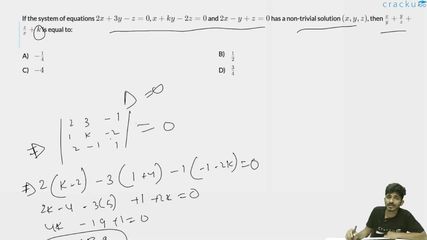
If the system of equations $$2x + 3y - z = 0$$, $$x + ky - 2z = 0$$ and $$2x - y + z = 0$$ has a non-trivial solution $$(x, y, z)$$, then $$\frac{x}{y} + \frac{y}{z} + \frac{z}{x} + k$$ is equal to:
First we note that a homogeneous linear system
$$\begin{cases} 2x+3y-z=0\\ x+ky-2z=0\\ 2x-y+z=0 \end{cases}$$
has a non-trivial solution only when the determinant of its coefficient matrix is zero. Stating the condition,
$$\det \begin{vmatrix} 2 & 3 & -1\\ 1 & k & -2\\ 2 & -1 & 1 \end{vmatrix}=0.$$
We expand this determinant along the first row:
$$ \begin{aligned} \det &= 2 \begin{vmatrix} k & -2\\ -1 & 1 \end{vmatrix} -3 \begin{vmatrix} 1 & -2\\ 2 & 1 \end{vmatrix} +(-1) \begin{vmatrix} 1 & k\\ 2 & -1 \end{vmatrix}.\\[6pt] \end{aligned} $$
Now we evaluate each $$2\times2$$ minor:
$$ \begin{aligned} \begin{vmatrix} k & -2\\ -1 & 1 \end{vmatrix}&=k(1)-(-2)(-1)=k-2,\\[4pt] \begin{vmatrix} 1 & -2\\ 2 & 1 \end{vmatrix}&=1(1)-(-2)(2)=1-(-4)=5,\\[4pt] \begin{vmatrix} 1 & k\\ 2 & -1 \end{vmatrix}&=1(-1)-k(2)=-1-2k. \end{aligned} $$
Substituting these back,
$$ \begin{aligned} \det &= 2(k-2)-3(5)+(-1)(-1-2k)\\ &=2k-4-15+1+2k\\ &=4k-18. \end{aligned} $$
The determinant must be zero for a non-trivial solution, so
$$4k-18=0 \;\;\Longrightarrow\;\; k=\frac{18}{4}=\frac{9}{2}.$$
With this value of $$k$$ the system becomes
$$\begin{cases} 2x+3y-z=0\\ x+\dfrac92\,y-2z=0\\ 2x-y+z=0 \end{cases}$$
We solve these equations to obtain the ratios among $$x,\;y,\;z$$. From the third equation,
$$2x-y+z=0\;\;\Longrightarrow\;\;y=2x+z.$$
We substitute this $$y$$ into the first equation:
$$ \begin{aligned} 2x+3(2x+z)-z&=0\\ 2x+6x+3z-z&=0\\ 8x+2z&=0\\ 4x+z&=0\\ z&=-4x. \end{aligned} $$
Putting $$z=-4x$$ back into $$y=2x+z$$ gives
$$y=2x+(-4x)=-2x.$$
Thus
$$x:y:z = x : -2x : -4x = 1 : -2 : -4.$$
Taking $$x=1,\;y=-2,\;z=-4$$ we compute the required expression
$$ \begin{aligned} \frac{x}{y}+\frac{y}{z}+\frac{z}{x}+k &=\frac{1}{-2}+\frac{-2}{-4}+\frac{-4}{1}+ \frac92\\[6pt] &=-\frac12+\frac12-4+\frac92\\[6pt] &=0-4+\frac92\\[6pt] &=-4+\frac92\\[6pt] &=\frac{-8+9}{2}\\[6pt] &=\frac12. \end{aligned} $$
Hence, the correct answer is Option B.
Was this solution helpful?
Click on the Email ☝️ to Watch the Video Solution
Create a FREE account and get:
_1.webp)

Educational materials for JEE preparation

Ask our AI anything

AI can make mistakes. Please verify important information.
AI can make mistakes. Please verify important information.


