
Join Our JEE Preparation Group
Prep with like-minded aspirants; Get access to free daily tests and study material.
Sign in
Please select an account to continue using cracku.in
↓ →
Join Our JEE Preparation Group
Prep with like-minded aspirants; Get access to free daily tests and study material.
Let $$P(\alpha, \beta, \gamma)$$ be the image of the point $$Q(3, -3, 1)$$ in the line $$\frac{x-0}{1} = \frac{y-3}{1} = \frac{z-1}{-1}$$ and $$R$$ be the point $$(2, 5, -1)$$. If the area of the triangle $$PQR$$ is $$\lambda$$ and $$\lambda^2 = 14K$$, then $$K$$ is equal to :
First, write the parametric form of the given line. We have $$\frac{x-0}{1} = \frac{y-3}{1} = \frac{z-1}{-1} = t$$. So a point on the line is $$A(0,3,1)$$ and direction vector is $$\mathbf d = (1,1,-1)$$.
To find the reflection point $$P$$ of $$Q(3,-3,1)$$ across the line, we first find the foot of the perpendicular from $$Q$$ to the line. The formula for the foot $$H$$ from a point $$Q$$ to a line passing through $$A$$ with direction $$\mathbf d$$ is:$$H = A + \frac{\mathbf d \cdot (Q - A)}{\mathbf d \cdot \mathbf d}\,\mathbf d\quad-(1)$$.
Compute $$Q - A = (3,-3,1)-(0,3,1) = (3,-6,0)$$. Then $$\mathbf d \cdot (Q-A) = (1,1,-1)\cdot(3,-6,0) = -3$$ and $$\mathbf d\cdot\mathbf d = 1^2+1^2+(-1)^2 = 3$$. Substituting into $$(1)$$ gives:$$H = (0,3,1) + \frac{-3}{3}(1,1,-1) = (0,3,1) - (1,1,-1) = (-1,2,2)\,$$.
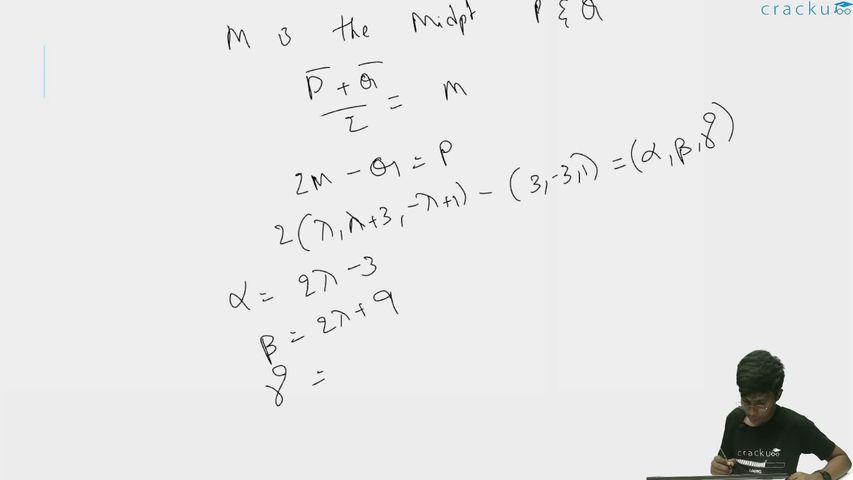
The reflection point $$P$$ is related to the foot $$H$$ by $$P = 2H - Q$$. Hence:$$P=2(-1,2,2)-(3,-3,1)=(-2,4,4)-(3,-3,1)=(-5,7,3)\,.$$
Next, let $$R=(2,5,-1)$$. To find the area of triangle $$PQR$$, we use the formula:$$\text{Area}=\tfrac12\bigl\lVert\overrightarrow{PQ}\times\overrightarrow{RQ}\bigr\rVert\quad-(2)$$.
Compute the vectors:$$\overrightarrow{PQ}=P-Q=(-5,7,3)-(3,-3,1)=(-8,10,2)\,,\quad \overrightarrow{RQ}=R-Q=(2,5,-1)-(3,-3,1)=(-1,8,-2)\,.$$
Compute the cross product using$$\overrightarrow{a}\times\overrightarrow{b}=(a_2b_3-a_3b_2,\;a_3b_1-a_1b_3,\;a_1b_2-a_2b_1)\,.$$ We get:$$\overrightarrow{PQ}\times\overrightarrow{RQ}=(-36,-18,-54)\,.$$
Its magnitude is$$\bigl\lVert(-36,-18,-54)\bigr\rVert=\sqrt{(-36)^2+(-18)^2+(-54)^2}=\sqrt{4536}=18\sqrt{14}\,.$$
Substituting into $$(2)$$ yields the area:$$\lambda=\tfrac12\cdot18\sqrt{14}=9\sqrt{14}\,.$$ Hence$$\lambda^2=(9\sqrt{14})^2=81\cdot14=14\cdot81\,.$$
Comparing with $$\lambda^2=14K$$ gives $$K=81$$. Therefore the correct option is Option B.
Was this solution helpful?
Click on the Email ☝️ to Watch the Video Solution
Create a FREE account and get:
_1.webp)

Educational materials for JEE preparation

Ask our AI anything

AI can make mistakes. Please verify important information.
AI can make mistakes. Please verify important information.
