
Join Our JEE Preparation Group
Prep with like-minded aspirants; Get access to free daily tests and study material.
Sign in
Please select an account to continue using cracku.in
↓ →
Join Our JEE Preparation Group
Prep with like-minded aspirants; Get access to free daily tests and study material.
Let $$L$$ be the line of intersection of planes $$\vec{r} \cdot (\hat{i} - \hat{j} + 2\hat{k}) = 2$$ and $$\vec{r} \cdot (2\hat{i} + \hat{j} - \hat{k}) = 2$$. If $$P(\alpha, \beta, \gamma)$$ is the foot of perpendicular on $$L$$ from the point $$(1, 2, 0)$$, then the value of $$35(\alpha + \beta + \gamma)$$ is equal to:
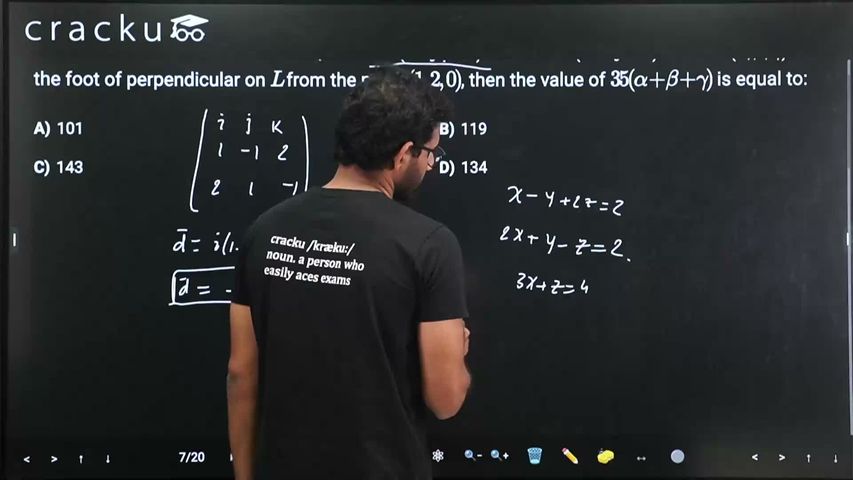
The two planes are $$x - y + 2z = 2$$ and $$2x + y - z = 2$$. The direction vector of the line of intersection $$L$$ is $$\vec{n_1} \times \vec{n_2} = (1, -1, 2) \times (2, 1, -1)$$.
Computing the cross product: $$\vec{n_1} \times \vec{n_2} = \begin{vmatrix} \hat{i} & \hat{j} & \hat{k} \\ 1 & -1 & 2 \\ 2 & 1 & -1 \end{vmatrix} = (1 - 2)\hat{i} - (-1 - 4)\hat{j} + (1 + 2)\hat{k} = -\hat{i} + 5\hat{j} + 3\hat{k}$$. So the direction of $$L$$ is $$(-1, 5, 3)$$.
To find a point on $$L$$, set $$z = 0$$: the equations become $$x - y = 2$$ and $$2x + y = 2$$. Adding: $$3x = 4$$, so $$x = \frac{4}{3}$$, $$y = -\frac{2}{3}$$. A point on $$L$$ is $$\left(\frac{4}{3}, -\frac{2}{3}, 0\right)$$.
The parametric form of $$L$$ is $$\left(\frac{4}{3} - t,\; -\frac{2}{3} + 5t,\; 3t\right)$$. The foot of perpendicular from $$P_0 = (1, 2, 0)$$ to $$L$$ satisfies the condition that the vector from the foot to $$P_0$$ is perpendicular to the direction $$(-1, 5, 3)$$.
The vector from the line point to $$P_0$$ is $$\left(1 - \frac{4}{3} + t,\; 2 + \frac{2}{3} - 5t,\; -3t\right) = \left(-\frac{1}{3} + t,\; \frac{8}{3} - 5t,\; -3t\right)$$. Taking the dot product with $$(-1, 5, 3)$$ and setting it to zero: $$-\!\left(-\frac{1}{3} + t\right) + 5\!\left(\frac{8}{3} - 5t\right) + 3(-3t) = 0$$, which gives $$\frac{1}{3} - t + \frac{40}{3} - 25t - 9t = 0$$, so $$\frac{41}{3} = 35t$$, hence $$t = \frac{41}{105}$$.
The foot of perpendicular is: $$\alpha = \frac{4}{3} - \frac{41}{105} = \frac{140 - 41}{105} = \frac{99}{105} = \frac{33}{35}$$, $$\beta = -\frac{2}{3} + \frac{205}{105} = \frac{-70 + 205}{105} = \frac{135}{105} = \frac{9}{7}$$, $$\gamma = \frac{123}{105} = \frac{41}{35}$$.
Therefore $$\alpha + \beta + \gamma = \frac{33}{35} + \frac{9}{7} + \frac{41}{35} = \frac{33 + 45 + 41}{35} = \frac{119}{35} = \frac{17}{5}$$, and $$35(\alpha + \beta + \gamma) = 35 \times \frac{17}{5} = 119$$.
Click on the Email ☝️ to Watch the Video Solution
Create a FREE account and get:
_1.webp)

Educational materials for JEE preparation

Ask our AI anything

AI can make mistakes. Please verify important information.
AI can make mistakes. Please verify important information.


