
Join Our JEE Preparation Group
Prep with like-minded aspirants; Get access to free daily tests and study material.
Sign in
Please select an account to continue using cracku.in
↓ →
Join Our JEE Preparation Group
Prep with like-minded aspirants; Get access to free daily tests and study material.
The area of the region enclosed between the parabolas $$y^2 = 2x - 1$$ and $$y^2 = 4x - 3$$ is
The two parabolas are $$y^2 = 2x - 1$$ (vertex at $$x = \frac{1}{2}$$) and $$y^2 = 4x - 3$$ (vertex at $$x = \frac{3}{4}$$). To find their intersection we set $$2x - 1 = 4x - 3$$, giving $$2x = 2$$ and $$x = 1$$. Then $$y^2 = 2(1) - 1 = 1$$, so $$y = \pm 1$$, and the intersection points are $$(1, 1)$$ and $$(1, -1)$$.
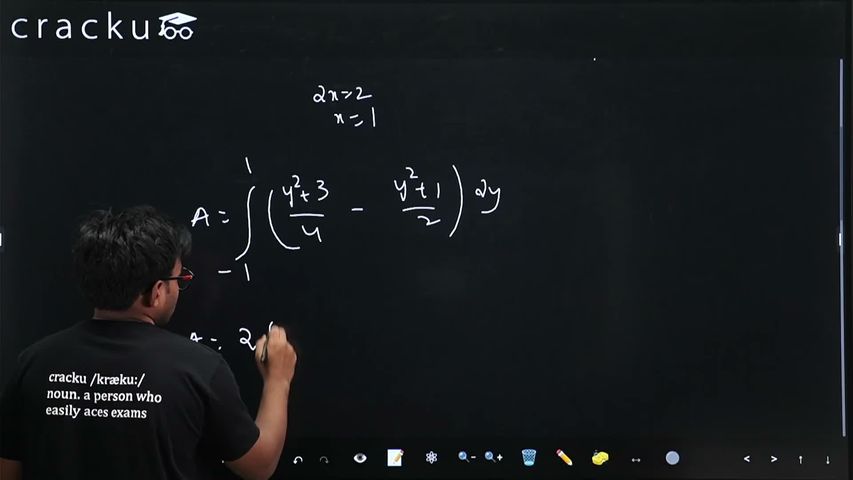
To compute the area between these curves we integrate with respect to $$y$$. From $$y^2 = 2x - 1$$ we get $$x = \frac{y^2 + 1}{2}$$, and from $$y^2 = 4x - 3$$ we get $$x = \frac{y^2 + 3}{4}$$. For $$-1 \leq y \leq 1$$, although one might check whether $$\frac{y^2 + 1}{2} \geq \frac{y^2 + 3}{4}$$, that simplifies to $$y^2 \geq 1$$, which is not true for $$|y| < 1$$. Instead, $$\frac{y^2 + 3}{4} \geq \frac{y^2 + 1}{2}$$ whenever $$1 \geq y^2$$, which holds for $$|y| \leq 1$$, so the second parabola gives the larger $$x$$ value in the enclosed region.
The area is
$$A = \int_{-1}^{1} \left(\frac{y^2 + 3}{4} - \frac{y^2 + 1}{2}\right) dy = \int_{-1}^{1} \frac{y^2 + 3 - 2y^2 - 2}{4}\,dy = \int_{-1}^{1} \frac{1 - y^2}{4}\,dy$$
By symmetry,
$$A = 2 \int_0^1 \frac{1 - y^2}{4}\,dy = \frac{1}{2}\int_0^1 (1 - y^2)\,dy = \frac{1}{2}\left[y - \frac{y^3}{3}\right]_0^1 = \frac{1}{2} \cdot \frac{2}{3} = \frac{1}{3}.$$
The area enclosed between the parabolas is $$\frac{1}{3}$$. The answer is Option A.
Was this solution helpful?
Click on the Email ☝️ to Watch the Video Solution
Create a FREE account and get:
_1.webp)

Educational materials for JEE preparation

Ask our AI anything

AI can make mistakes. Please verify important information.
AI can make mistakes. Please verify important information.


