
Join Our JEE Preparation Group
Prep with like-minded aspirants; Get access to free daily tests and study material.
Sign in
Please select an account to continue using cracku.in
↓ →
Join Our JEE Preparation Group
Prep with like-minded aspirants; Get access to free daily tests and study material.
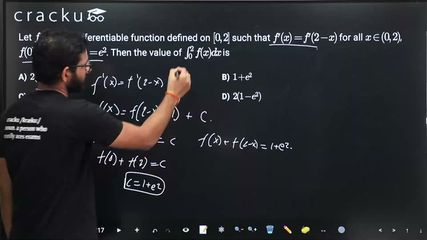
Let $$f(x)$$ be a differentiable function defined on $$[0, 2]$$ such that $$f'(x) = f'(2 - x)$$ for all $$x \in (0, 2)$$, $$f(0) = 1$$ and $$f(2) = e^2$$. Then the value of $$\int_0^2 f(x)dx$$ is
We are given that $$f'(x) = f'(2 - x)$$ for all $$x \in (0, 2)$$. Integrating both sides with respect to $$x$$, we get $$f(x) = -f(2 - x) + C$$ for some constant $$C$$, which can be rewritten as $$f(x) + f(2 - x) = C$$.
To find $$C$$, we substitute $$x = 0$$: $$f(0) + f(2) = C$$, so $$C = 1 + e^2$$. Therefore, $$f(x) + f(2 - x) = 1 + e^2$$ for all $$x \in [0, 2]$$.
Now we evaluate the integral $$I = \int_0^2 f(x)\,dx$$. Using the substitution $$x \to 2 - x$$, we also have $$I = \int_0^2 f(2 - x)\,dx$$. Adding these two expressions gives $$2I = \int_0^2 [f(x) + f(2 - x)]\,dx = \int_0^2 (1 + e^2)\,dx = 2(1 + e^2)$$.
Therefore, $$I = 1 + e^2$$.
The correct answer is $$1 + e^2$$.
Was this solution helpful?
Click on the Email ☝️ to Watch the Video Solution
Create a FREE account and get:
_1.webp)

Educational materials for JEE preparation

Ask our AI anything

AI can make mistakes. Please verify important information.
AI can make mistakes. Please verify important information.


