
Join Our JEE Preparation Group
Prep with like-minded aspirants; Get access to free daily tests and study material.
Sign in
Please select an account to continue using cracku.in
↓ →
Join Our JEE Preparation Group
Prep with like-minded aspirants; Get access to free daily tests and study material.
Let the function $$f: [0, 2] \to \mathbb{R}$$ be defined as $$f(x) = \begin{cases} e^{\min\{x^2, x-[x]\}}, & x \in [0, 1) \\ e^{[x - \log_e x]}, & x \in [1, 2] \end{cases}$$, where $$[t]$$ denotes the greatest integer less than or equal to $$t$$. Then the value of the integral $$\int_0^2 xf(x)dx$$ is
We wish to evaluate $$\int_0^2 x f(x)\,dx$$ where $$f(x)=\begin{cases}e^{\min\{x^2,\,x-[x]\}}, & x\in[0,1)\\e^{[\,x-\ln x\,]}, & x\in[1,2]\,. \end{cases}$$
Since for $$x\in[0,1)$$ we have $$[x]=0$$, it follows that $$x-[x]=x$$ and because $$x^2\le x$$ on $$[0,1]$$ we conclude $$\min\{x^2,x\}=x^2$$; hence on this interval $$f(x)=e^{x^2}$$.
Moreover, on the interval $$[1,2]$$ the function $$x-\ln x$$ increases from $$1-\ln1=1$$ to $$2-\ln2\approx1.307<2$$, so that $$x-\ln x\in[1,2)$$ and therefore $$[\,x-\ln x\,]=1$$, giving $$f(x)=e$$ there.
Therefore the integral splits as $$\int_0^2 x f(x)\,dx=\int_0^1 x e^{x^2}\,dx+\int_1^2 x e\,dx\;.$$
Next, to compute the first integral, we set $$u=x^2$$ so that $$du=2x\,dx$$, which yields $$\int_0^1 x e^{x^2}\,dx=\frac12\int_0^1 e^u\,du=\frac12(e-1)=\frac{e-1}{2}\;.$$
Similarly, for the second integral we find $$e\int_1^2 x\,dx=e\Bigl[\frac{x^2}{2}\Bigr]_1^2=e\Bigl(2-\tfrac12\Bigr)=\frac{3e}{2}\;.$$
From the above, adding these results gives $$\frac{e-1}{2}+\frac{3e}{2}=\frac{4e-1}{2}=2e-\frac12\;,$$ so the value of the integral is $$2e-\frac12$$.
Was this solution helpful?
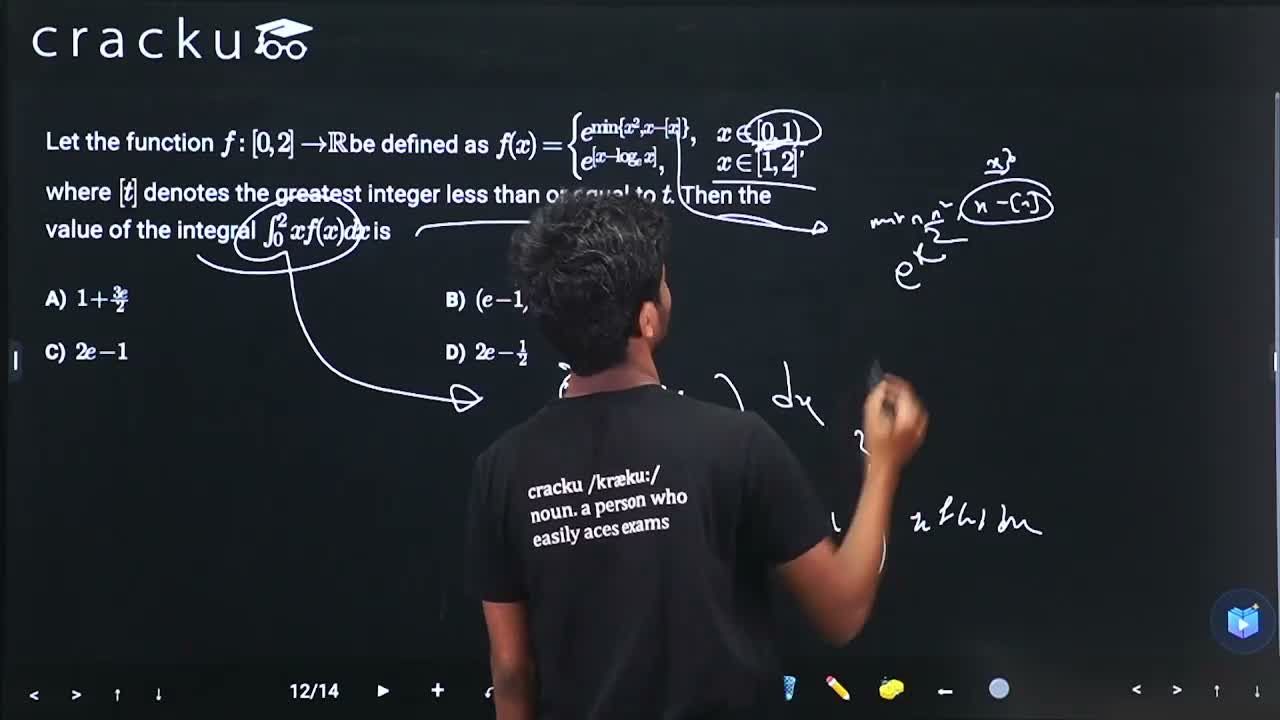
Click on the Email ☝️ to Watch the Video Solution
Create a FREE account and get:
_1.webp)

Educational materials for JEE preparation

Ask our AI anything

AI can make mistakes. Please verify important information.
AI can make mistakes. Please verify important information.


