
Join Our JEE Preparation Group
Prep with like-minded aspirants; Get access to free daily tests and study material.
Sign in
Please select an account to continue using cracku.in
↓ →
Join Our JEE Preparation Group
Prep with like-minded aspirants; Get access to free daily tests and study material.
Let $$C_1$$ be the curve obtained by the solution of differential equation $$2xy\frac{dy}{dx} = y^2 - x^2$$, $$x > 0$$. Let the curve $$C_2$$ be the solution of $$\frac{2xy}{x^2-y^2} = \frac{dy}{dx}$$. If both the curves pass through $$(1, 1)$$, then the area (in sq. units) enclosed by the curves $$C_1$$ and $$C_2$$ is equal to:
For curve $$C_1$$: $$2xy \frac{dy}{dx} = y^2 - x^2$$. Using the substitution $$y = vx$$, so $$\frac{dy}{dx} = v + x\frac{dv}{dx}$$:
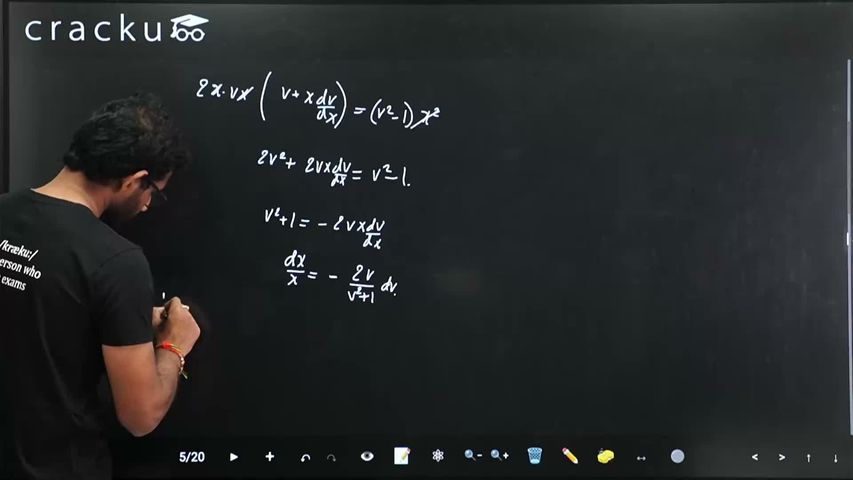
$$2x \cdot vx\left(v + x\frac{dv}{dx}\right) = v^2x^2 - x^2$$. Simplifying: $$2v\left(v + x\frac{dv}{dx}\right) = v^2 - 1$$, so $$2v^2 + 2vx\frac{dv}{dx} = v^2 - 1$$, giving $$2vx\frac{dv}{dx} = -(v^2 + 1)$$.
Separating variables: $$\frac{2v \, dv}{v^2 + 1} = -\frac{dx}{x}$$. Integrating: $$\ln(v^2 + 1) = -\ln|x| + C$$, so $$x(v^2 + 1) = K$$. Substituting back: $$x\left(\frac{y^2}{x^2} + 1\right) = K$$, i.e., $$x^2 + y^2 = Kx$$. Passing through $$(1, 1)$$: $$K = 2$$. So $$C_1: x^2 + y^2 = 2x$$, a circle centered at $$(1, 0)$$ with radius 1.
For curve $$C_2$$: $$\frac{dy}{dx} = \frac{2xy}{x^2 - y^2}$$. Using the same substitution $$y = vx$$:
$$v + x\frac{dv}{dx} = \frac{2v}{1 - v^2}$$, so $$x\frac{dv}{dx} = \frac{2v - v + v^3}{1 - v^2} = \frac{v(1 + v^2)}{1 - v^2}$$.
Separating: $$\frac{(1-v^2)}{v(1+v^2)} dv = \frac{dx}{x}$$. Using partial fractions: $$\frac{1-v^2}{v(1+v^2)} = \frac{1}{v} - \frac{2v}{1+v^2}$$.
Integrating: $$\ln|v| - \ln(1+v^2) = \ln|x| + C$$, so $$\frac{v}{1+v^2} = Ax$$, giving $$\frac{y}{x^2 + y^2} = A$$. Through $$(1,1)$$: $$A = \frac{1}{2}$$. So $$C_2: x^2 + y^2 = 2y$$, a circle centered at $$(0, 1)$$ with radius 1.
The two circles have radius $$r = 1$$ each and their centers are distance $$d = \sqrt{2}$$ apart. The area enclosed between them equals the area of intersection of the two circles:
$$\text{Area} = 2r^2 \cos^{-1}\left(\frac{d}{2r}\right) - \frac{d}{2}\sqrt{4r^2 - d^2} = 2 \cos^{-1}\left(\frac{\sqrt{2}}{2}\right) - \frac{\sqrt{2}}{2}\sqrt{4 - 2} = 2 \cdot \frac{\pi}{4} - \frac{\sqrt{2}}{2} \cdot \sqrt{2} = \frac{\pi}{2} - 1$$.
Was this solution helpful?
Click on the Email ☝️ to Watch the Video Solution
Create a FREE account and get:
_1.webp)

Educational materials for JEE preparation

Ask our AI anything

AI can make mistakes. Please verify important information.
AI can make mistakes. Please verify important information.
