
Join Our JEE Preparation Group
Prep with like-minded aspirants; Get access to free daily tests and study material.
Sign in
Please select an account to continue using cracku.in
↓ →
Join Our JEE Preparation Group
Prep with like-minded aspirants; Get access to free daily tests and study material.
Let a vector $$\alpha\hat{i} + \beta\hat{j}$$ be obtained by rotating the vector $$\sqrt{3}\hat{i} + \hat{j}$$ by an angle 45° about the origin in counterclockwise direction in the first quadrant. Then the area (in sq. units) of triangle having vertices $$(\alpha, \beta)$$, $$(0, \beta)$$ and $$(0, 0)$$ is equal to:
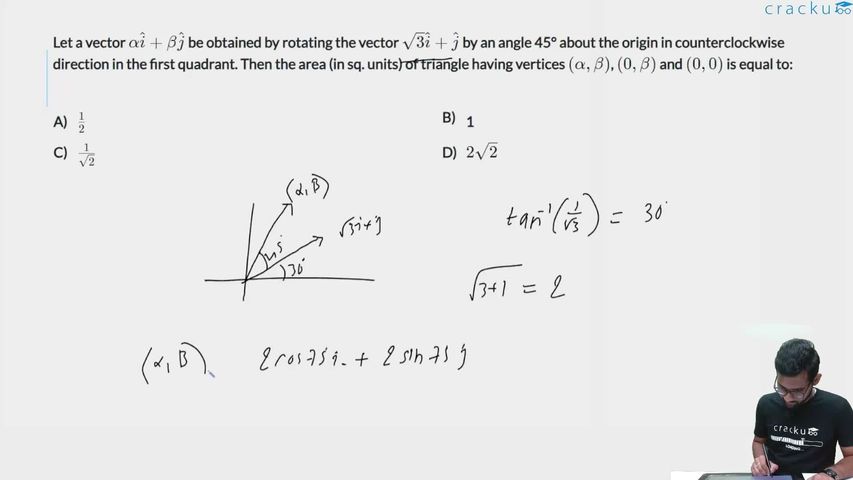
The vector $$\sqrt{3}\hat{i} + \hat{j}$$ has magnitude $$\sqrt{3 + 1} = 2$$ and makes an angle $$\theta = \tan^{-1}\left(\frac{1}{\sqrt{3}}\right) = 30°$$ with the positive x-axis.
Rotating this vector by $$45°$$ counterclockwise gives a new angle of $$30° + 45° = 75°$$. The magnitude remains 2, so the new vector is $$\alpha\hat{i} + \beta\hat{j} = 2\cos 75°\hat{i} + 2\sin 75°\hat{j}$$.
The triangle has vertices $$(\alpha, \beta)$$, $$(0, \beta)$$, and $$(0, 0)$$. This is a right triangle with the right angle at $$(0, \beta)$$, with base along the y-axis of length $$|\beta|$$ and horizontal side of length $$|\alpha|$$.
The area is $$\frac{1}{2}|\alpha||\beta| = \frac{1}{2} \cdot 2\cos 75° \cdot 2\sin 75° = 2\cos 75°\sin 75° = \sin 150° = \frac{1}{2}$$.
Was this solution helpful?
Click on the Email ☝️ to Watch the Video Solution
Create a FREE account and get:
_1.webp)

Educational materials for JEE preparation

Ask our AI anything

AI can make mistakes. Please verify important information.
AI can make mistakes. Please verify important information.
