
Join Our JEE Preparation Group
Prep with like-minded aspirants; Get access to free daily tests and study material.
Sign in
Please select an account to continue using cracku.in
↓ →
Join Our JEE Preparation Group
Prep with like-minded aspirants; Get access to free daily tests and study material.
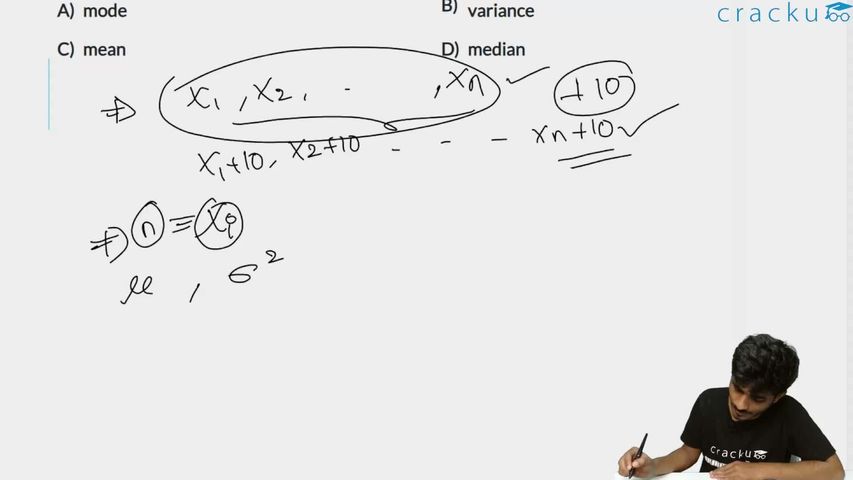
All the students of a class performed poorly in Mathematics. The teacher decided to give grace marks of 10 to each of the students. Which of the following statistical measures will not change even after the grace marks were given?
Let the original Mathematics scores of the $$n$$ students be denoted by
$$x_1,\;x_2,\;x_3,\;\dots ,\;x_n.$$
The teacher now gives a grace of 10 marks to every student, so each score increases by the same constant. Therefore the new scores become
$$y_1 = x_1 + 10,\;y_2 = x_2 + 10,\;y_3 = x_3 + 10,\;\dots ,\;y_n = x_n + 10.$$
Mean
The mean (average) of the original scores is defined by the formula
$$\bar x = \frac{1}{n}\sum_{i=1}^{n} x_i.$$
The mean of the new scores is
$$\bar y = \frac{1}{n}\sum_{i=1}^{n} y_i = \frac{1}{n}\sum_{i=1}^{n} (x_i + 10) = \frac{1}{n}\left( \sum_{i=1}^{n} x_i + \sum_{i=1}^{n} 10 \right) = \frac{1}{n}\sum_{i=1}^{n} x_i + \frac{1}{n}\,(10n) = \bar x + 10.$$
So the mean increases by 10 and therefore changes.
Median
The median is the middle value when the data are arranged in ascending order. Adding the same constant 10 to every observation shifts every value upward by 10 but keeps their order unchanged. Thus the middle position still corresponds to the same student, and the median simply becomes
$$\text{new median} \;=\; \text{old median} + 10.$$
Hence the median also changes.
Mode
The mode is the most frequently occurring value. If the original modal value is $$m$$, every occurrence of $$m$$ turns into $$m + 10$$, and there is no change in the frequency pattern. Consequently, the new mode is
$$m + 10,$$
so the mode too changes.
Variance
The variance measures the spread of the data about their mean. Its population formula is
$$\sigma^2 = \frac{1}{n}\sum_{i=1}^{n} (x_i - \bar x)^2.$$
For the new data we have the mean $$\bar y = \bar x + 10$$ as derived earlier. The variance of the new scores is
$$\sigma_y^2 = \frac{1}{n}\sum_{i=1}^{n} (y_i - \bar y)^2 = \frac{1}{n}\sum_{i=1}^{n} \bigl[(x_i + 10) - (\bar x + 10)\bigr]^2 = \frac{1}{n}\sum_{i=1}^{n} (x_i - \bar x)^2 = \sigma^2.$$
The +10 and −10 cancel inside the brackets, leaving exactly the same squared differences as before. Therefore the numerical value of the variance remains unchanged.
Among the four measures—mode, variance, mean and median—only the variance retains its original value after every observation is increased by the same constant 10.
Hence, the correct answer is Option B.
Was this solution helpful?
Click on the Email ☝️ to Watch the Video Solution
Create a FREE account and get:
_1.webp)

Educational materials for JEE preparation

Ask our AI anything

AI can make mistakes. Please verify important information.
AI can make mistakes. Please verify important information.
