
Join Our JEE Preparation Group
Prep with like-minded aspirants; Get access to free daily tests and study material.
Sign in
Please select an account to continue using cracku.in
↓ →
Join Our JEE Preparation Group
Prep with like-minded aspirants; Get access to free daily tests and study material.
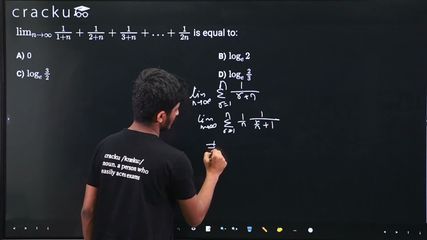
$$\lim_{n \to \infty} \frac{1}{1+n} + \frac{1}{2+n} + \frac{1}{3+n} + \ldots + \frac{1}{2n}$$ is equal to:
We need to evaluate $$\lim_{n \to \infty} \left(\frac{1}{1+n} + \frac{1}{2+n} + \frac{1}{3+n} + \ldots + \frac{1}{2n}\right)$$.
Write the sum in sigma notation.
$$ S_n = \sum_{k=1}^{n} \frac{1}{k+n} $$
Convert to a Riemann sum.
Factor out $$\frac{1}{n}$$ from each term:
$$ S_n = \sum_{k=1}^{n} \frac{1}{n} \cdot \frac{1}{\frac{k}{n} + 1} $$
This is a Riemann sum for the integral $$\int_0^1 \frac{1}{x+1}\, dx$$, where the interval $$[0, 1]$$ is divided into $$n$$ equal subintervals of width $$\Delta x = 1/n$$, and the sample points are $$x_k = k/n$$.
As $$n \to \infty$$, the Riemann sum converges to the definite integral:
$$ \lim_{n \to \infty} S_n = \int_0^1 \frac{dx}{x+1} $$
Evaluate the integral.
Using the standard integral $$\int \frac{dx}{x+1} = \ln|x+1| + C$$:
$$ \int_0^1 \frac{dx}{x+1} = \left[\ln(x+1)\right]_0^1 = \ln(1+1) - \ln(0+1) = \ln 2 - \ln 1 = \ln 2 $$
Therefore, the limit is $$\log_e 2$$.
The correct answer is Option 2: $$\log_e 2$$.
Was this solution helpful?
Click on the Email ☝️ to Watch the Video Solution
Create a FREE account and get:
_1.webp)

Educational materials for JEE preparation

Ask our AI anything

AI can make mistakes. Please verify important information.
AI can make mistakes. Please verify important information.
