
Join Our JEE Preparation Group
Prep with like-minded aspirants; Get access to free daily tests and study material.
Sign in
Please select an account to continue using cracku.in
↓ →
Join Our JEE Preparation Group
Prep with like-minded aspirants; Get access to free daily tests and study material.
Let the normal at a point P on the curve $$y^2 - 3x^2 + y + 10 = 0$$ intersect the y-axis at $$\left(0, \frac{3}{2}\right)$$. If $$m$$ is the slope of the tangent at P to the curve, then $$|m|$$ is equal to
Correct Answer: 4
We have the curve $$y^{2}-3x^{2}+y+10=0$$ and a point $$P(x_{1},y_{1})$$ on it such that the normal at P meets the y-axis at $$\left(0,\dfrac32\right)$$. Our aim is to find the slope $$m$$ of the tangent at P and then its absolute value.
First, we need the slope of the tangent at an arbitrary point of the curve. Implicitly differentiating $$y^{2}-3x^{2}+y+10=0$$ with respect to $$x$$, we get
$$\dfrac{d}{dx}\bigl(y^{2}\bigr)-\dfrac{d}{dx}\bigl(3x^{2}\bigr)+\dfrac{d}{dx}(y)+\dfrac{d}{dx}(10)=0,$$
$$2y\,\dfrac{dy}{dx}-6x+\dfrac{dy}{dx}=0.$$
Collecting the $$\dfrac{dy}{dx}$$ terms,
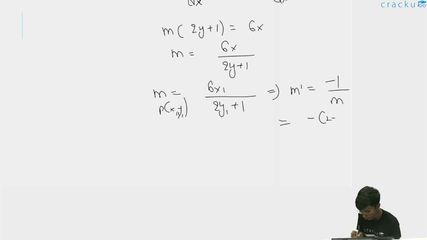
$$(2y+1)\dfrac{dy}{dx}=6x.$$
Hence, the slope of the tangent is
$$m=\dfrac{dy}{dx}=\dfrac{6x}{\,2y+1\,}.$$
The slope of the normal is the negative reciprocal of the slope of the tangent, so
$$\text{Slope of normal}= -\dfrac{1}{m}= -\dfrac{2y+1}{6x}.$$
On the other hand, the normal passes through $$P(x_{1},y_{1})$$ and the point $$\left(0,\dfrac32\right)$$ on the y-axis. Using the two-point form, the slope of this normal is also
$$\dfrac{y_{1}-\dfrac32}{x_{1}-0}= \dfrac{y_{1}-\dfrac32}{x_{1}}.$$
Equating the two expressions for the slope of the normal we obtain
$$\dfrac{y_{1}-\dfrac32}{x_{1}}=-\,\dfrac{2y_{1}+1}{6x_{1}}.$$
Because $$x_{1}\neq0$$ (otherwise the normal would be vertical and could not meet the y-axis at a finite point), we can cancel $$x_{1}$$ from both sides:
$$y_{1}-\dfrac32=-\,\dfrac{2y_{1}+1}{6}.$$
Multiplying by 6 to clear the denominator,
$$6y_{1}-9=-(2y_{1}+1).$$
Bringing all terms involving $$y_{1}$$ to the left,
$$6y_{1}-9=-2y_{1}-1$$
$$8y_{1}-9=-1$$
$$8y_{1}=8$$
$$y_{1}=1.$$
Now we substitute $$y_{1}=1$$ into the original curve to find $$x_{1}$$:
$$1^{2}-3x_{1}^{2}+1+10=0$$
$$1-3x_{1}^{2}+1+10=0$$
$$12-3x_{1}^{2}=0$$
$$3x_{1}^{2}=12$$
$$x_{1}^{2}=4$$
$$x_{1}=2\quad\text{or}\quad x_{1}=-2.$$
Finally, we compute the slope $$m$$ for each value of $$x_{1}$$ using the formula $$m=\dfrac{6x_{1}}{2y_{1}+1}.$$ Since $$y_{1}=1$$, we have $$2y_{1}+1=3$$, so
For $$x_{1}=2:\qquad m=\dfrac{6\cdot2}{3}=4.$$ For $$x_{1}=-2:\quad m=\dfrac{6\cdot(-2)}{3}=-4.$$
Thus the slope of the tangent can be $$4$$ or $$-4$$, and in either case
$$|m|=4.$$
Hence, the correct answer is Option 4.
Was this solution helpful?
Click on the Email ☝️ to Watch the Video Solution
Create a FREE account and get:
_1.webp)

Educational materials for JEE preparation

Ask our AI anything

AI can make mistakes. Please verify important information.
AI can make mistakes. Please verify important information.
