
Join Our JEE Preparation Group
Prep with like-minded aspirants; Get access to free daily tests and study material.
Sign in
Please select an account to continue using cracku.in
↓ →
Join Our JEE Preparation Group
Prep with like-minded aspirants; Get access to free daily tests and study material.
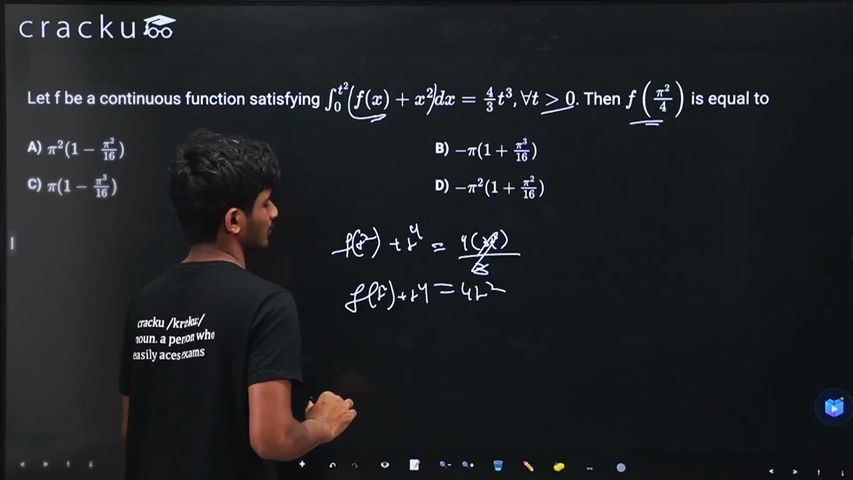
Let f be a continuous function satisfying $$\int_0^{t^2} f(x) + x^2 dx = \frac{4}{3}t^3$$, $$\forall t > 0$$. Then $$f\left(\frac{\pi^{2}}{4}\right)$$ is equal to
We are given that $$\displaystyle\int_0^{t^2} \left(f(x) + x^2\right) dx = \frac{4}{3}\,t^3$$ for all $$t>0$$, and we wish to determine $$f\!\left(\frac{\pi^2}{4}\right)\,.$$
Applying the Leibniz integral rule, if $$\displaystyle\int_0^{g(t)} h(x)\, dx = F(t)$$ then $$h(g(t)) \cdot g'(t) = F'(t)\,. $$ Taking $$g(t)=t^2$$ so that $$g'(t)=2t$$ and $$h(x)=f(x)+x^2\,, $$ we differentiate both sides of the given equation with respect to $$t$$:
$$\left(f(t^2) + (t^2)^2\right) \cdot 2t = \frac{d}{dt}\left(\frac{4}{3}\,t^3\right) = 4t^2\,. $$
Dividing both sides by $$2t$$ (valid since $$t>0$$) gives
$$f(t^2) + t^4 = 2t$$
and therefore
$$f(t^2) = 2t - t^4\,. $$
To find the value at $$t^2=\frac{\pi^2}{4}$$ we take $$t=\frac{\pi}{2}$$ and substitute to obtain
$$f\!\left(\frac{\pi^2}{4}\right) = 2 \cdot \frac{\pi}{2} - \left(\frac{\pi}{2}\right)^4 = \pi - \frac{\pi^4}{16}\,. $$
Factoring this expression leads to
$$f\!\left(\frac{\pi^2}{4}\right) = \pi\left(1 - \frac{\pi^3}{16}\right)\,. $$
The answer is Option C: $$\pi\!\left(1 - \dfrac{\pi^3}{16}\right)$$.
Was this solution helpful?
Click on the Email ☝️ to Watch the Video Solution
Create a FREE account and get:
_1.webp)

Educational materials for JEE preparation

Ask our AI anything

AI can make mistakes. Please verify important information.
AI can make mistakes. Please verify important information.


