
Join Our JEE Preparation Group
Prep with like-minded aspirants; Get access to free daily tests and study material.
Sign in
Please select an account to continue using cracku.in
↓ →
Join Our JEE Preparation Group
Prep with like-minded aspirants; Get access to free daily tests and study material.
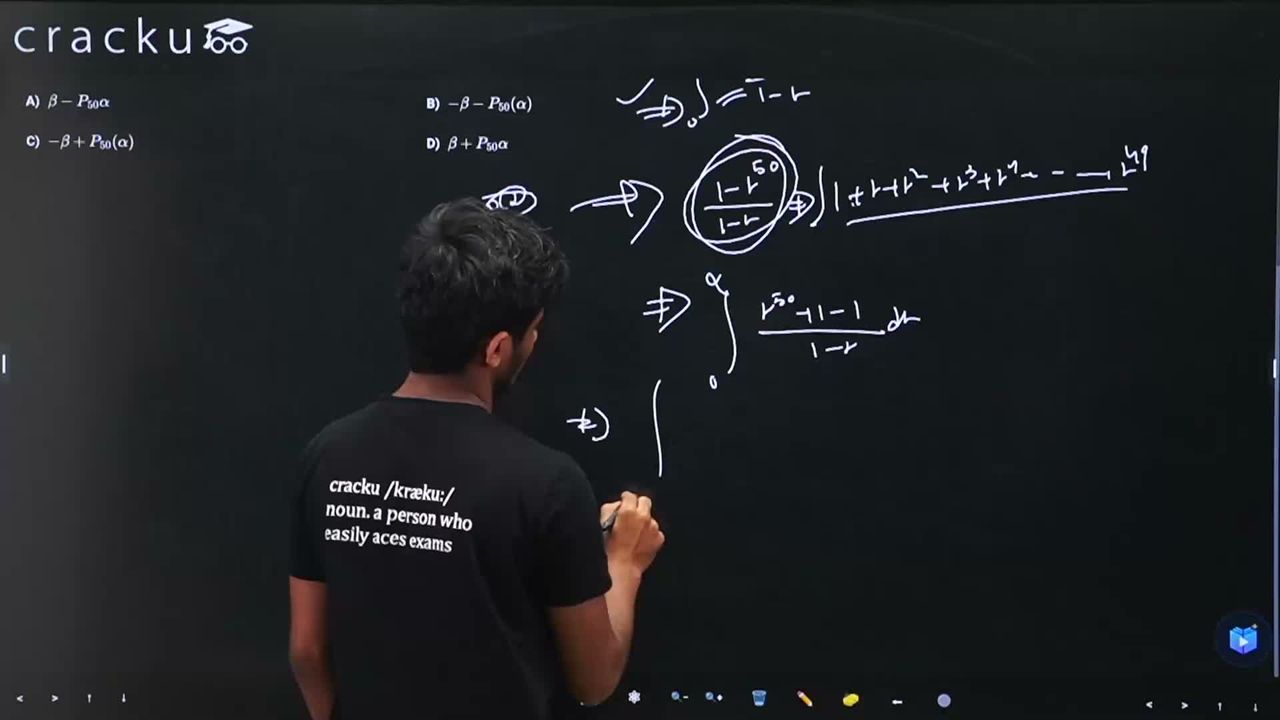
Let $$\alpha \in (0, 1)$$ and $$\beta = \log_e(1 - \alpha)$$. Let $$P_n(x) = x + \dfrac{x^2}{2} + \dfrac{x^3}{3} + \ldots + \dfrac{x^n}{n}$$, $$x \in (0, 1)$$. Then the integral $$\int_0^{\alpha} \dfrac{t^{50}}{1-t} dt$$ is equal to
Given $$\alpha \in (0,1)$$, $$\beta = \log_e(1-\alpha)$$, and $$P_n(x) = x + \dfrac{x^2}{2} + \dfrac{x^3}{3} + \cdots + \dfrac{x^n}{n}$$. We wish to evaluate $$\displaystyle\int_0^{\alpha} \dfrac{t^{50}}{1-t}\,dt$$.
Observing that the integrand can be rewritten as
$$\frac{t^{50}}{1-t} = \frac{t^{50} - 1}{1-t} + \frac{1}{1-t} = -(1 + t + t^2 + \cdots + t^{49}) + \frac{1}{1-t}$$
the integral therefore splits into two parts:
$$\int_0^{\alpha} \frac{t^{50}}{1-t}\,dt = -\int_0^{\alpha}(1 + t + \cdots + t^{49})\,dt + \int_0^{\alpha}\frac{1}{1-t}\,dt$$
The first integral evaluates to
$$\int_0^{\alpha}(1 + t + \cdots + t^{49})\,dt = \alpha + \frac{\alpha^2}{2} + \cdots + \frac{\alpha^{50}}{50} = P_{50}(\alpha)$$
while the second integral gives
$$\int_0^{\alpha}\frac{1}{1-t}\,dt = \left[-\ln(1-t)\right]_0^{\alpha} = -\ln(1-\alpha) = -\beta$$
Combining these results yields
$$\int_0^{\alpha}\frac{t^{50}}{1-t}\,dt = -P_{50}(\alpha) - \beta$$
Thus the integral equals $$-(\beta + P_{50}(\alpha))$$, which matches Option B.
Was this solution helpful?
Click on the Email ☝️ to Watch the Video Solution
Create a FREE account and get:
_1.webp)

Educational materials for JEE preparation

Ask our AI anything

AI can make mistakes. Please verify important information.
AI can make mistakes. Please verify important information.
