
Join Our JEE Preparation Group
Prep with like-minded aspirants; Get access to free daily tests and study material.
Sign in
Please select an account to continue using cracku.in
↓ →
Join Our JEE Preparation Group
Prep with like-minded aspirants; Get access to free daily tests and study material.
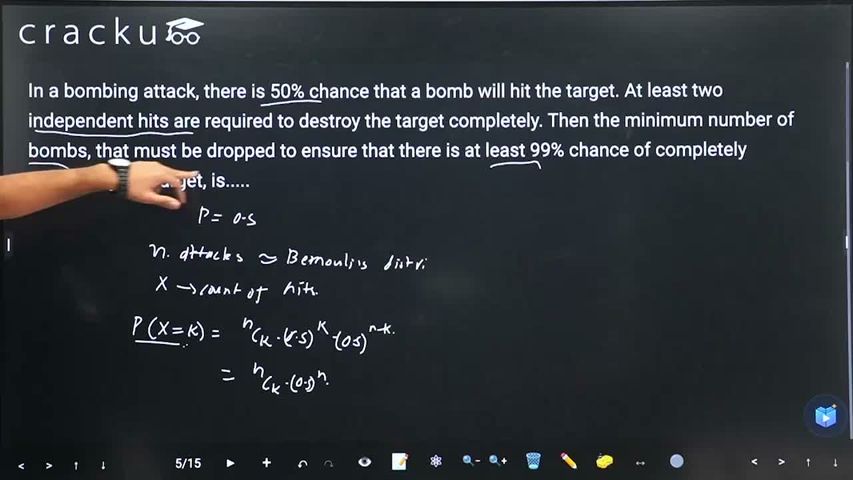
In a bombing attack, there is 50% chance that a bomb will hit the target. At least two independent hits are required to destroy the target completely. Then the minimum number of bombs, that must be dropped to ensure that there is at least 99% chance of completely destroying the target, is.....
Correct Answer: 11
We are told that every bomb hits the target with probability $$p = 0.5$$, and each bomb acts independently of the others. Let us drop $$n$$ bombs and define a random variable $$X$$ that counts the number of hits among these $$n$$ bombs. Because each bomb can be thought of as a Bernoulli trial (Hit = success, Miss = failure), $$X$$ follows the binomial distribution with parameters $$n$$ and $$p$$. The probability mass function for a binomially distributed variable is stated by the formula
$$\Pr(X = k) = \binom{n}{k}\,p^{\,k}\,(1-p)^{\,n-k}, \qquad k = 0,1,2,\dots ,n.$$
The target is completely destroyed if we obtain at least two hits, i.e. if $$X \ge 2$$. We therefore want
$$\Pr(X \ge 2) \ge 0.99.$$
Instead of summing many terms to find $$\Pr(X \ge 2)$$ directly, it is easier to use the complement rule. We have the basic identity
$$\Pr(X \ge 2) = 1 - \Pr(X \le 1) = 1 - \bigl[\Pr(X = 0) + \Pr(X = 1)\bigr].$$
So our requirement translates into
$$1 - \bigl[\Pr(X = 0) + \Pr(X = 1)\bigr] \;\ge\; 0.99.$$
Rearranging, this is equivalent to
$$\Pr(X = 0) + \Pr(X = 1) \;\le\; 0.01.$$
Now we calculate the two individual probabilities using the binomial formula.
First, for zero hits:
$$\Pr(X = 0) = \binom{n}{0}\,p^{\,0}\,(1-p)^{\,n} = 1 \times 1 \times (1-0.5)^{\,n} = 0.5^{\,n}.$$
Next, for exactly one hit:
$$\Pr(X = 1) = \binom{n}{1}\,p^{\,1}\,(1-p)^{\,n-1} = n \times 0.5 \times 0.5^{\,n-1} = n \times 0.5^{\,n}.$$
Adding these two probabilities gives
$$\Pr(X = 0) + \Pr(X = 1) = 0.5^{\,n} + n \times 0.5^{\,n} = (1+n)\,0.5^{\,n}.$$
Our inequality $$\Pr(X = 0) + \Pr(X = 1) \le 0.01$$ therefore becomes
$$(1+n)\,0.5^{\,n} \;\le\; 0.01.$$
Because $$0.5^{\,n} = \dfrac{1}{2^{\,n}}$$, we can rewrite the left side as
$$(1+n)\,\dfrac{1}{2^{\,n}} = \dfrac{1+n}{2^{\,n}},$$
so the inequality we need to satisfy is
$$\dfrac{1+n}{2^{\,n}} \;\le\; 0.01.$$
To find the minimum integer $$n$$ meeting this condition, we test successive values of $$n$$ starting from small integers and stop as soon as the inequality holds.
• For $$n = 10$$, $$\dfrac{1+10}{2^{\,10}} = \dfrac{11}{1024} \approx 0.010742 \;>\; 0.01.$$ This is slightly larger than $$0.01$$, so ten bombs are not enough.
• For $$n = 11$$, $$\dfrac{1+11}{2^{\,11}} = \dfrac{12}{2048} \approx 0.005859 \;<\; 0.01.$$ Now the inequality is satisfied and we have reached the required confidence level.
Because $$n = 10$$ fails while $$n = 11$$ succeeds, the smallest possible number of bombs that achieves the desired $$99\%$$ chance of completely destroying the target is $$n = 11$$.
So, the answer is $$11$$.
Was this solution helpful?
Click on the Email ☝️ to Watch the Video Solution
Create a FREE account and get:
_1.webp)

Educational materials for JEE preparation

Ask our AI anything

AI can make mistakes. Please verify important information.
AI can make mistakes. Please verify important information.
