
Join Our JEE Preparation Group
Prep with like-minded aspirants; Get access to free daily tests and study material.
Sign in
Please select an account to continue using cracku.in
↓ →
Join Our JEE Preparation Group
Prep with like-minded aspirants; Get access to free daily tests and study material.
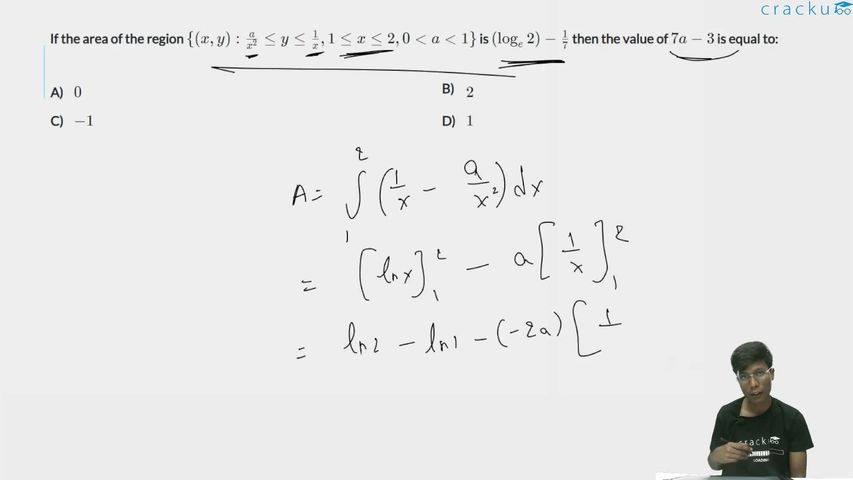
If the area of the region $$\{(x, y) : \frac{a}{x^2} \leq y \leq \frac{1}{x}, 1 \leq x \leq 2, 0 < a < 1\}$$ is $$(\log_e 2) - \frac{1}{7}$$ then the value of $$7a - 3$$ is equal to:
We need to find the value of $$7a - 3$$ given that the area of the region $$\{(x,y): \frac{a}{x^2} \leq y \leq \frac{1}{x}, 1 \leq x \leq 2, 0 < a < 1\}$$ equals $$\ln 2 - \frac{1}{7}$$.
To determine this value, we first set up the area integral by noting that the area between the curves $$y_1 = \frac{a}{x^2}$$ (lower curve) and $$y_2 = \frac{1}{x}$$ (upper curve) over the interval $$x \in [1,2]$$ is given by
$$ A = \int_1^2 \left(\frac{1}{x} - \frac{a}{x^2}\right) dx $$. We integrate the difference $$y_2 - y_1$$ because $$y_2 \geq y_1$$ in this region (for $$0 < a < 1$$).
We now evaluate each integral separately. First,
$$ \int_1^2 \frac{1}{x}\,dx = [\ln x]_1^2 = \ln 2 - \ln 1 = \ln 2 $$.
For the second integral, recall that $$\int x^{-2}\,dx = \frac{x^{-1}}{-1} = -\frac{1}{x}$$:
$$ \int_1^2 \frac{a}{x^2}\,dx = a\left[-\frac{1}{x}\right]_1^2 = a\left(-\frac{1}{2} - \left(-\frac{1}{1}\right)\right) = a\left(-\frac{1}{2} + 1\right) = \frac{a}{2} $$.
Combining these results, the total area satisfies
$$ A = \ln 2 - \frac{a}{2} = \ln 2 - \frac{1}{7} $$.
Solving for $$a$$ by subtracting $$\ln 2$$ from both sides gives
$$ -\frac{a}{2} = -\frac{1}{7} $$. Hence, $$ \frac{a}{2} = \frac{1}{7} $$ and therefore $$ a = \frac{2}{7} $$.
Finally,
$$ 7a - 3 = 7 \times \frac{2}{7} - 3 = 2 - 3 = -1 $$.
The correct answer is Option C: $$-1$$.
Was this solution helpful?
Click on the Email ☝️ to Watch the Video Solution
Create a FREE account and get:
_1.webp)

Educational materials for JEE preparation

Ask our AI anything

AI can make mistakes. Please verify important information.
AI can make mistakes. Please verify important information.
