
Join Our JEE Preparation Group
Prep with like-minded aspirants; Get access to free daily tests and study material.
Sign in
Please select an account to continue using cracku.in
↓ →
Join Our JEE Preparation Group
Prep with like-minded aspirants; Get access to free daily tests and study material.
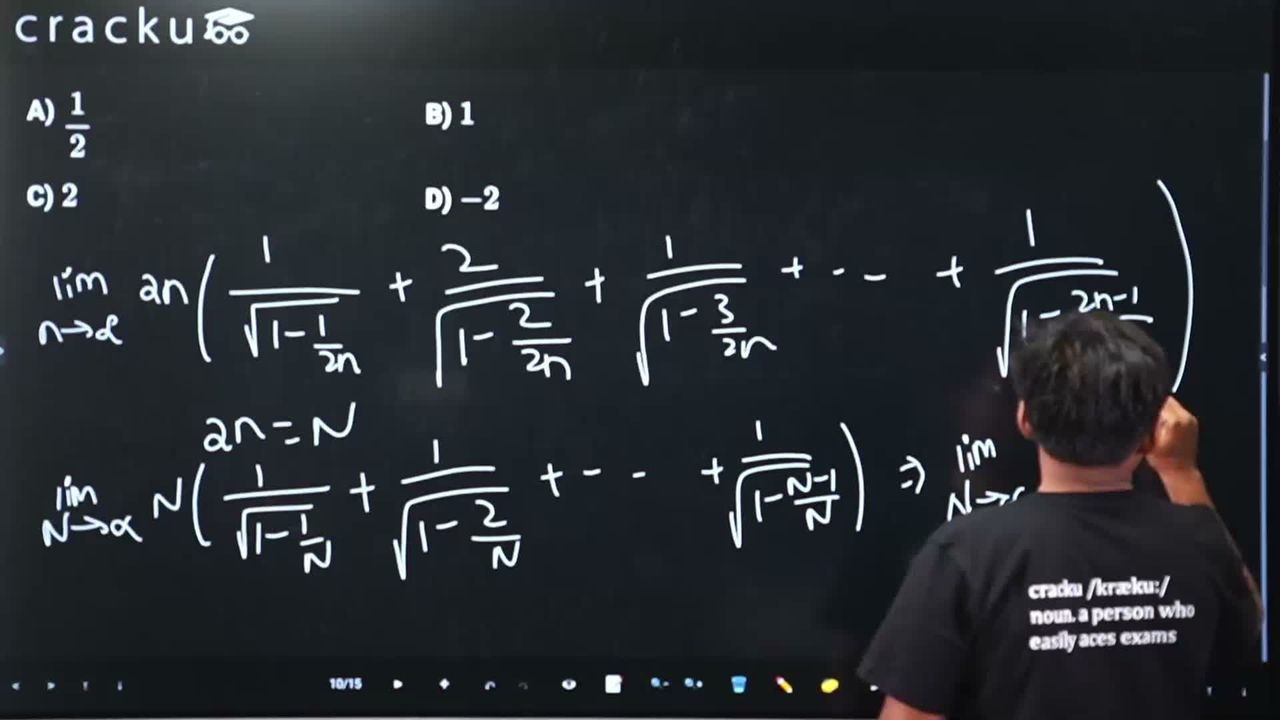
$$\displaystyle\lim_{n \to \infty} \dfrac{1}{2n}\left(\dfrac{1}{\sqrt{1 - \frac{1}{2n}}} + \dfrac{1}{\sqrt{1 - \frac{2}{2n}}} + \dfrac{1}{\sqrt{1 - \frac{3}{2n}}} + \ldots + \dfrac{1}{\sqrt{1 - \frac{2n-1}{2n}}}\right)$$ is equal to
We need to evaluate:
$$
\lim_{n \to \infty} \frac{1}{2n}\left(\frac{1}{\sqrt{1 - \frac{1}{2n}}} + \frac{1}{\sqrt{1 - \frac{2}{2n}}} + \cdots + \frac{1}{\sqrt{1 - \frac{2n-1}{2n}}}\right)
$$
Setting $$N = 2n$$ transforms the expression into
$$
\frac{1}{N}\sum_{k=1}^{N-1} \frac{1}{\sqrt{1 - \frac{k}{N}}}
$$
This sum can be recognized as a Riemann sum for the function $$f(x) = \dfrac{1}{\sqrt{1-x}}$$ on the interval $$[0,1]$$, taking sample points $$x_k = \dfrac{k}{N}$$ with step size $$\Delta x = \dfrac{1}{N}$$. Although $$f(x)$$ becomes unbounded as $$x\to1$$, the corresponding improper integral converges, and thus the Riemann sum converges to the integral in the limit as $$N\to\infty$$:
$$
\lim_{N \to \infty} \frac{1}{N}\sum_{k=1}^{N-1} \frac{1}{\sqrt{1-k/N}} = \int_0^1 \frac{1}{\sqrt{1-x}}\,dx
$$
To evaluate the integral, substitute $$u = 1-x$$ so that $$du = -dx$$. This gives
$$
\int_0^1 \frac{dx}{\sqrt{1-x}} = \int_1^0 \frac{-du}{\sqrt{u}} = \int_0^1 u^{-1/2}\,du = \left[2\sqrt{u}\right]_0^1 = 2(1)-2(0) = 2
$$
The answer is Option C: $$2$$.
Was this solution helpful?
Click on the Email ☝️ to Watch the Video Solution
Create a FREE account and get:
_1.webp)

Educational materials for JEE preparation

Ask our AI anything

AI can make mistakes. Please verify important information.
AI can make mistakes. Please verify important information.
