
Join Our JEE Preparation Group
Prep with like-minded aspirants; Get access to free daily tests and study material.
Sign in
Please select an account to continue using cracku.in
↓ →
Join Our JEE Preparation Group
Prep with like-minded aspirants; Get access to free daily tests and study material.
Let $$f(x) = 3\sin^4 x + 10\sin^3 x + 6\sin^2 x - 3$$, $$x \in \left[-\frac{\pi}{6}, \frac{\pi}{2}\right]$$. Then, $$f$$ is:
We have the function
$$f(x)=3\sin^4x+10\sin^3x+6\sin^2x-3,$$
defined for $$x\in\left[-\dfrac{\pi}{6},\dfrac{\pi}{2}\right].$$ To study where the function is increasing or decreasing we need its first derivative.
First, recall the chain-rule differentiation formula:
$$\dfrac{d}{dx}\bigl[\sin^n x\bigr]=n\sin^{\,n-1}x\cdot\cos x.$$
Using this rule term-by-term we get
$$$\begin{aligned} \dfrac{d}{dx}\bigl[3\sin^4x\bigr] &=3\cdot4\sin^{3}x\cos x=12\sin^{3}x\cos x,\\[4pt] \dfrac{d}{dx}\bigl[10\sin^3x\bigr] &=10\cdot3\sin^{2}x\cos x=30\sin^{2}x\cos x,\\[4pt] \dfrac{d}{dx}\bigl[6\sin^2x\bigr] &=6\cdot2\sin x\cos x=12\sin x\cos x,\\[4pt] \dfrac{d}{dx}\bigl[-3\bigr] &=0. \end{aligned}$$$
Adding them, the derivative is
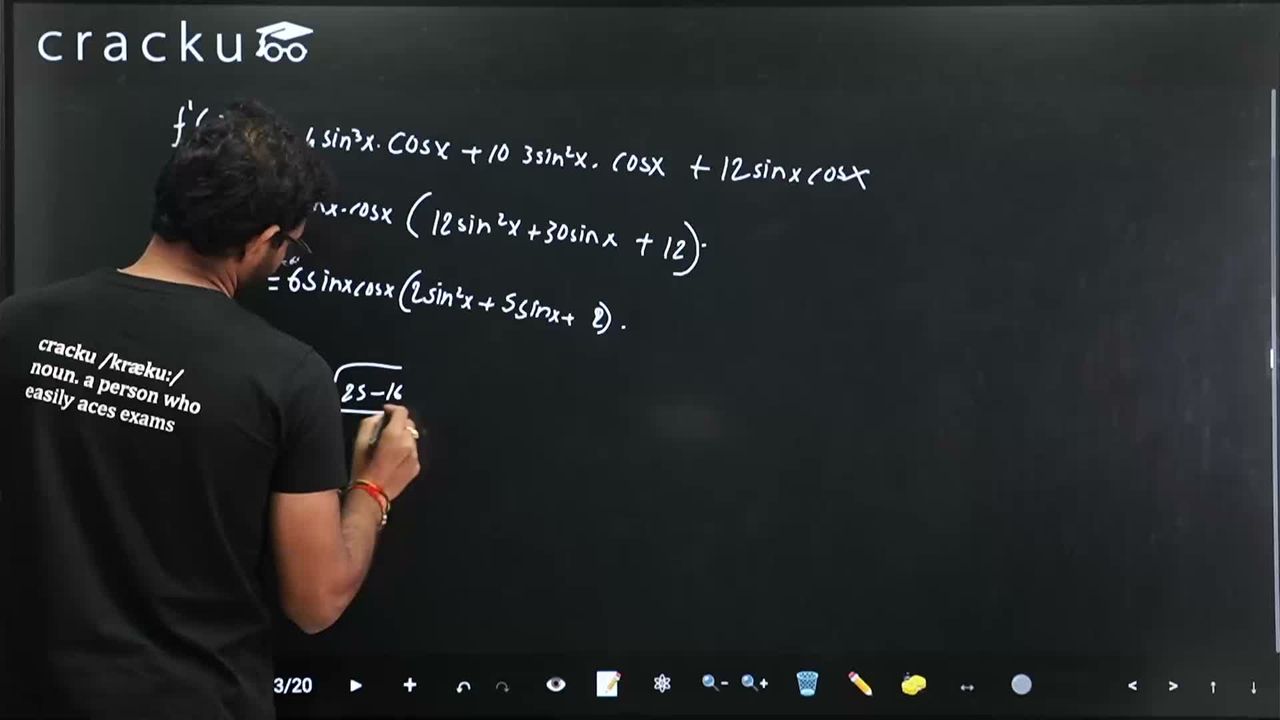
$$$\begin{aligned} f'(x)&=12\sin^{3}x\cos x+30\sin^{2}x\cos x+12\sin x\cos x\\[6pt] &=\cos x\bigl(12\sin^{3}x+30\sin^{2}x+12\sin x\bigr). \end{aligned}$$$
Now we factor the polynomial in $$\sin x$$ inside the parentheses. First take the common factor $$6\sin x$$:
$$$12\sin^{3}x+30\sin^{2}x+12\sin x =6\sin x\bigl(2\sin^{2}x+5\sin x+2\bigr).$$$
Hence
$$$f'(x)=6\sin x\;\cos x\;\bigl(2\sin^{2}x+5\sin x+2\bigr).$$$
We must study the sign of each factor on the interval $$\left(-\dfrac{\pi}{6},\dfrac{\pi}{2}\right).$$
Factor 1: $$\cos x.$$ For $$x\in\left(-\dfrac{\pi}{6},\dfrac{\pi}{2}\right)$$ we have $$\cos x>0$$ because the cosine is positive in the first and fourth quadrants up to $$\dfrac{\pi}{2}.$$
Factor 2: $$\sin x.$$ This changes sign at $$x=0:$$
Factor 3: $$2\sin^{2}x+5\sin x+2.$$ Put $$t=\sin x.$$ Then we analyse the quadratic
$$q(t)=2t^{2}+5t+2.$$ Its discriminant is $$\Delta=5^{2}-4\cdot2\cdot2=25-16=9,$$ so the roots are $$t=\dfrac{-5\pm\sqrt9}{2\cdot2}=\dfrac{-5\pm3}{4},$$ that is, $$t_{1}=-2,\qquad t_{2}=-\dfrac12.$$ Because the leading coefficient $$2>0,$$ the quadratic is positive outside the interval between its roots and negative inside it. Within the range $$-1\le t\le1$$ that $$\sin x$$ can attain, only the root $$t=-\dfrac12$$ is relevant. Consequently
Note that $$\sin\bigl(-\tfrac{\pi}{6}\bigr)=-\dfrac12,$$ so on $$\left(-\dfrac{\pi}{6},0\right)$$ we actually have $$\sin x\in\bigl(-\dfrac12,0\bigr),$$ and therefore $$2\sin^{2}x+5\sin x+2>0$$ throughout the whole sub-interval.
Now we collect the signs interval-wise.
For $$x\in\left(-\dfrac{\pi}{6},0\right):$$
$$$\cos x>0,\qquad \sin x<0,\qquad 2\sin^{2}x+5\sin x+2>0.$$$
Multiplying, we get
$$f'(x)=\bigl(+\bigr)\bigl(-\bigr)\bigl(+\bigr)=\boxed{-}.$$
So $$f'(x)<0,$$ meaning $$f(x)$$ is strictly decreasing on $$\left(-\dfrac{\pi}{6},0\right).$$
For $$x\in\left(0,\dfrac{\pi}{2}\right):$$
$$$\cos x>0,\qquad \sin x>0,\qquad 2\sin^{2}x+5\sin x+2>0.$$$
Hence
$$f'(x)=\bigl(+\bigr)\bigl(+\bigr)\bigl(+\bigr)=\boxed{+},$$
so $$f(x)$$ is strictly increasing on $$\left(0,\dfrac{\pi}{2}\right).$$
Combining the two results:
Among the given options, only Option D states that $$f$$ is decreasing on $$\left(-\dfrac{\pi}{6},0\right).$$
Hence, the correct answer is Option D.
Was this solution helpful?
Click on the Email ☝️ to Watch the Video Solution
Create a FREE account and get:
_1.webp)

Educational materials for JEE preparation

Ask our AI anything

AI can make mistakes. Please verify important information.
AI can make mistakes. Please verify important information.
