
Join Our JEE Preparation Group
Prep with like-minded aspirants; Get access to free daily tests and study material.
Sign in
Please select an account to continue using cracku.in
↓ →
Join Our JEE Preparation Group
Prep with like-minded aspirants; Get access to free daily tests and study material.
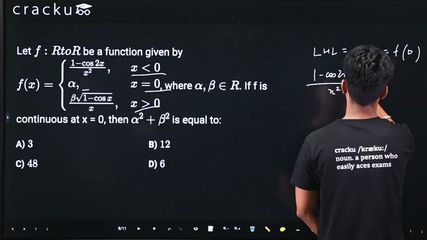
Let $$f : R to R$$ be a function given by $$f(x) = \begin{cases}\frac{1-\cos 2x}{x^2}, & x < 0\\ \alpha, & x = 0\\ \frac{\beta\sqrt{1-\cos x}}{x}, & x > 0\end{cases}$$, where $$\alpha, \beta \in R$$. If f is continuous at x = 0, then $$\alpha^2 + \beta^2$$ is equal to:
As x→0⁻: $$(1-\cos2x)/x^2=2\sin^2x/x$$² → 2.
So α = 2.
As x→0⁺: $$β\sqrt{(}1-\cos x)/x=β·\sqrt{(}2\sin^2(x/2))/x=β·\sqrt{2}|\sin(x/2)|/x\approxβ·\sqrt{2}·(x/2)/x=β/(\sqrt{2})$$
$$\sqrt{(}1-\cos x)$$ = $$\sqrt{(}2\sin^2(x/2))=\sqrt{2}|\sin(x/2)|\approx\sqrt{2}·x/2$$for small x>0
So $$β\sqrt{(}1-\cos x)/x\approx β·\sqrt{2}·x/(2x)$$= β/√2
For continuity: $$β/\sqrt{2}$$ = 2, so β = 2√2
α² + β² = 4 + 8 = 12
Was this solution helpful?
Click on the Email ☝️ to Watch the Video Solution
Create a FREE account and get:
_1.webp)

Educational materials for JEE preparation

Ask our AI anything

AI can make mistakes. Please verify important information.
AI can make mistakes. Please verify important information.
