
Join Our JEE Preparation Group
Prep with like-minded aspirants; Get access to free daily tests and study material.
Sign in
Please select an account to continue using cracku.in
↓ →
Join Our JEE Preparation Group
Prep with like-minded aspirants; Get access to free daily tests and study material.
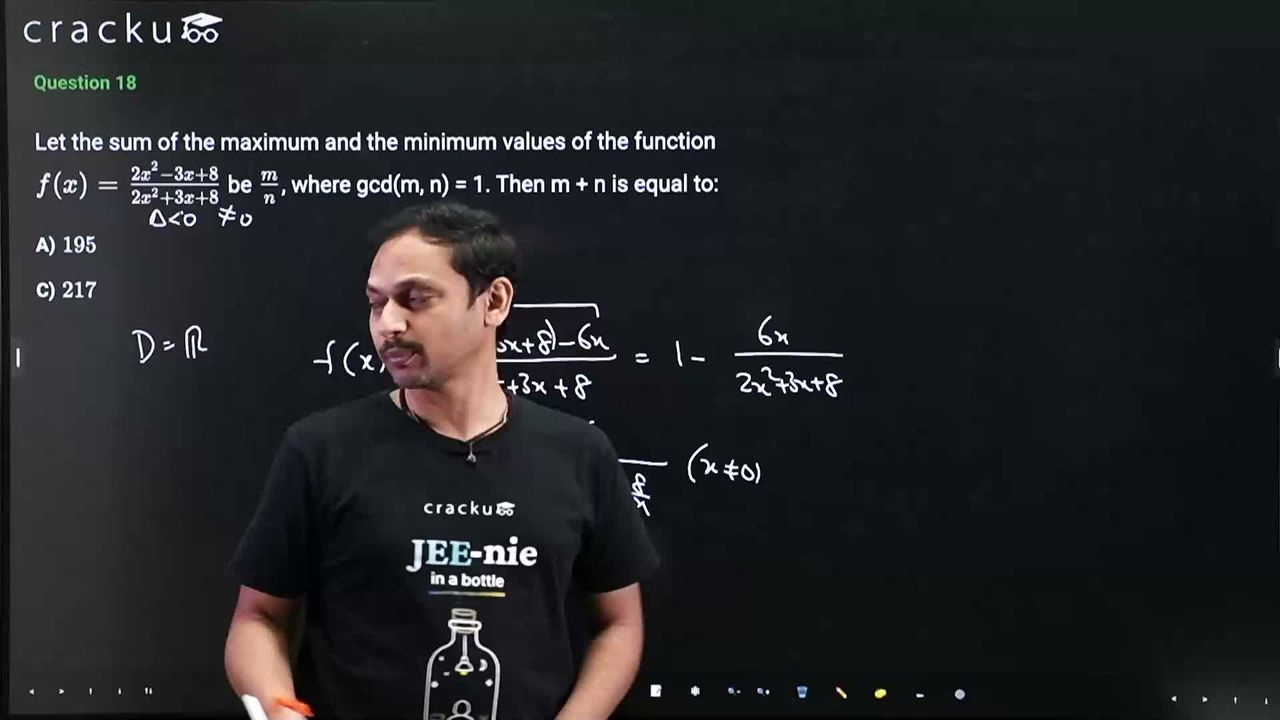
Let the sum of the maximum and the minimum values of the function $$f(x) = \frac{2x^2-3x+8}{2x^2+3x+8}$$ be $$\frac{m}{n}$$, where gcd(m, n) = 1. Then m + n is equal to:
Let the range of $$f(x)=\dfrac{2x^{2}-3x+8}{2x^{2}+3x+8}$$ be $$\left[f_{\min},\,f_{\max}\right]$$. To find $$f_{\min}$$ and $$f_{\max}$$, set $$f(x)=y$$ and eliminate $$x$$.
$$y=\dfrac{2x^{2}-3x+8}{2x^{2}+3x+8}$$ Cross-multiplying gives $$y\bigl(2x^{2}+3x+8\bigr)=2x^{2}-3x+8$$ $$\Longrightarrow(2-2y)x^{2}+(-3-3y)x+(8-8y)=0$$
Factor the common terms: $$2(1-y)x^{2}-3(1+y)x+8(1-y)=0 \;-(1)$$ Equation $$(1)$$ is quadratic in $$x$$. For real $$x$$, its discriminant must satisfy $$\Delta\ge 0$$.
Coefficients of $$(1)$$ are $$A=2(1-y),\;B=-3(1+y),\;C=8(1-y)$$. Hence $$\Delta=B^{2}-4AC$$ $$\Delta=\bigl[-3(1+y)\bigr]^{2}-4\cdot2(1-y)\cdot8(1-y)$$ $$\Delta=9(1+y)^{2}-64(1-y)^{2}$$
Expand both squares: $$(1+y)^{2}=1+2y+y^{2},\qquad(1-y)^{2}=1-2y+y^{2}$$ $$\therefore\;\Delta=9(1+2y+y^{2})-64(1-2y+y^{2})$$ $$\Delta=9+18y+9y^{2}-64+128y-64y^{2}$$ $$\Delta=-55y^{2}+146y-55$$
For real $$x$$, $$\Delta\ge 0$$, so $$-55y^{2}+146y-55\;\ge\;0$$ Multiply by $$-1$$ (reversing the inequality): $$55y^{2}-146y+55\;\le\;0 \;-(2)$$
Quadratic $$(2)$$ in $$y$$ has roots $$y=\dfrac{146\pm\sqrt{146^{2}-4\cdot55\cdot55}}{2\cdot55}$$ Compute the discriminant: $$146^{2}-4\cdot55\cdot55=21316-12100=9216=96^{2}$$ Thus the roots are $$y_{1}=\dfrac{146-96}{110}=\dfrac{50}{110}=\dfrac{5}{11},\qquad y_{2}=\dfrac{146+96}{110}=\dfrac{242}{110}=\dfrac{11}{5}$$
Because the coefficient $$55$$ in $$(2)$$ is positive, inequality $$(2)$$ holds for $$y$$ lying between the roots. Therefore $$\boxed{\dfrac{5}{11}\;\le\;y\;\le\;\dfrac{11}{5}}$$ Hence $$f_{\min}=\dfrac{5}{11},\qquad f_{\max}=\dfrac{11}{5}$$
The required sum is $$f_{\min}+f_{\max}=\dfrac{5}{11}+\dfrac{11}{5}$$ Take the common denominator $$55$$: $$=\dfrac{25}{55}+\dfrac{121}{55}=\dfrac{146}{55}$$
Here $$m=146,\;n=55$$ with $$\gcd(m,n)=1$$, so $$m+n=146+55=201$$.
The correct option is Option B (201).
Was this solution helpful?
Click on the Email ☝️ to Watch the Video Solution
Create a FREE account and get:
_1.webp)

Educational materials for JEE preparation

Ask our AI anything

AI can make mistakes. Please verify important information.
AI can make mistakes. Please verify important information.
