
Join Our JEE Preparation Group
Prep with like-minded aspirants; Get access to free daily tests and study material.
Sign in
Please select an account to continue using cracku.in
↓ →
Join Our JEE Preparation Group
Prep with like-minded aspirants; Get access to free daily tests and study material.
The system of equations $$kx + y + z = 1$$, $$x + ky + z = k$$ and $$x + y + zk = k^2$$ has no solution if $$k$$ is equal to:
The system of equations is: $$kx + y + z = 1$$ $$-(1)$$, $$x + ky + z = k$$ $$-(2)$$, $$x + y + kz = k^2$$ $$-(3)$$.
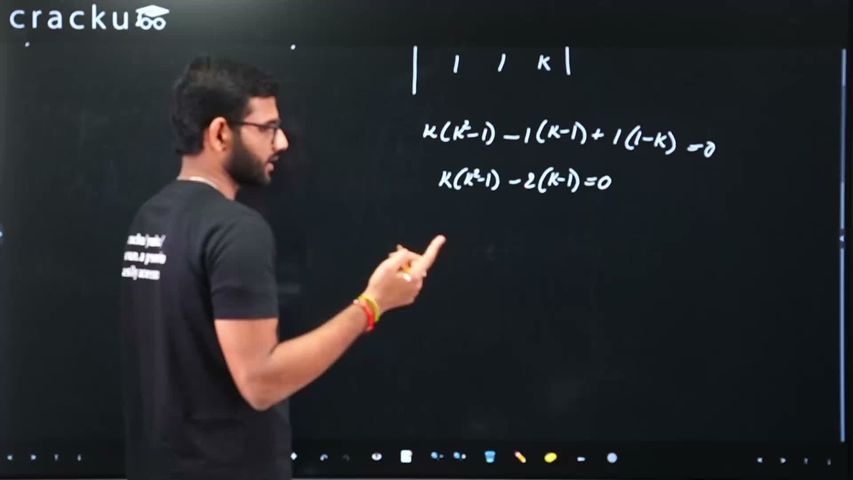
The coefficient matrix is $$A = \begin{bmatrix} k & 1 & 1 \\ 1 & k & 1 \\ 1 & 1 & k \end{bmatrix}$$.
Computing $$\det(A)$$: add all three columns to the first column: $$C_1 \to C_1 + C_2 + C_3$$, giving $$\begin{bmatrix} k+2 & 1 & 1 \\ k+2 & k & 1 \\ k+2 & 1 & k \end{bmatrix}$$.
Factor out $$(k+2)$$: $$\det(A) = (k+2) \begin{vmatrix} 1 & 1 & 1 \\ 1 & k & 1 \\ 1 & 1 & k \end{vmatrix}$$.
Apply $$R_2 \to R_2 - R_1$$ and $$R_3 \to R_3 - R_1$$: $$= (k+2) \begin{vmatrix} 1 & 1 & 1 \\ 0 & k-1 & 0 \\ 0 & 0 & k-1 \end{vmatrix} = (k+2)(k-1)^2$$.
For no solution, we need $$\det(A) = 0$$, so $$k = -2$$ or $$k = 1$$.
When $$k = 1$$: all three equations become $$x + y + z = 1$$, which has infinitely many solutions (not "no solution").
When $$k = -2$$: the equations become $$-2x + y + z = 1$$, $$x - 2y + z = -2$$, $$x + y - 2z = 4$$. Adding all three: $$0 = 3$$, which is a contradiction. So the system has no solution.
Therefore $$k = -2$$, which matches Option D.
Was this solution helpful?
Click on the Email ☝️ to Watch the Video Solution
Create a FREE account and get:
_1.webp)

Educational materials for JEE preparation

Ask our AI anything

AI can make mistakes. Please verify important information.
AI can make mistakes. Please verify important information.
