
Join Our JEE Preparation Group
Prep with like-minded aspirants; Get access to free daily tests and study material.
Sign in
Please select an account to continue using cracku.in
↓ →
Join Our JEE Preparation Group
Prep with like-minded aspirants; Get access to free daily tests and study material.
The number of optical isomers exhibited by the iron complex (A) obtained from the following reaction is _________.
$$FeCl_3 + KOH + H_2C_2O_4 \to A$$
Correct Answer: 2
The reagents $$FeCl_3$$, $$KOH$$ and $$H_2C_2O_4$$ react in two stages.
First, the alkali converts oxalic acid into oxalate ion:
$$H_2C_2O_4 + 2\,KOH \rightarrow K_2C_2O_4 + 2\,H_2O$$
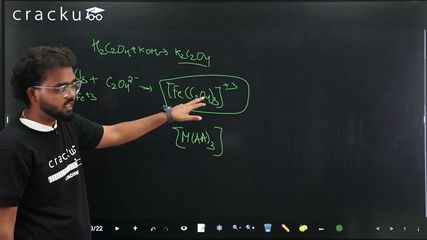
The freshly-generated $$C_2O_4^{2-}$$ (oxalate) then acts as a bidentate ligand toward the $$Fe^{3+}$$ ion obtained from $$FeCl_3$$.
Because $$Fe^{3+}$$ has six vacant coordination sites, three oxalate ions can chelate to it, giving the octahedral complex
$$K_3\,[Fe(C_2O_4)_3] \; \longleftrightarrow \; [Fe(C_2O_4)_3]^{3-} \; = \; \text{(A)}$$
Each $$C_2O_4^{2-}$$ ligand occupies two adjacent sites, so the stoichiometry is of the general type $$[M(AA)_3]$$, where $$(AA)$$ is any symmetrical bidentate ligand.
For an octahedral complex of the form $$[M(AA)_3]$$:
• All six donor atoms are fixed in positions that give only one geometrical arrangement (no cis-trans possibilities).
• However, the three chelate rings can interlock in two nonsuperimposable mirror-image arrangements, conventionally named the $$\Lambda$$ and $$\Delta$$ forms.
Thus such a complex exhibits optical isomerism, producing one pair of enantiomers.
Number of optical isomers $$= 2$$ (one $$\Lambda$$ and one $$\Delta$$).
Therefore, the iron complex (A) shows $$\mathbf{2}$$ optical isomers.
Click on the Email ☝️ to Watch the Video Solution
Create a FREE account and get:
_1.webp)

Educational materials for JEE preparation

Ask our AI anything

AI can make mistakes. Please verify important information.
AI can make mistakes. Please verify important information.


