
Join Our JEE Preparation Group
Prep with like-minded aspirants; Get access to free daily tests and study material.
Sign in
Please select an account to continue using cracku.in
↓ →
Join Our JEE Preparation Group
Prep with like-minded aspirants; Get access to free daily tests and study material.
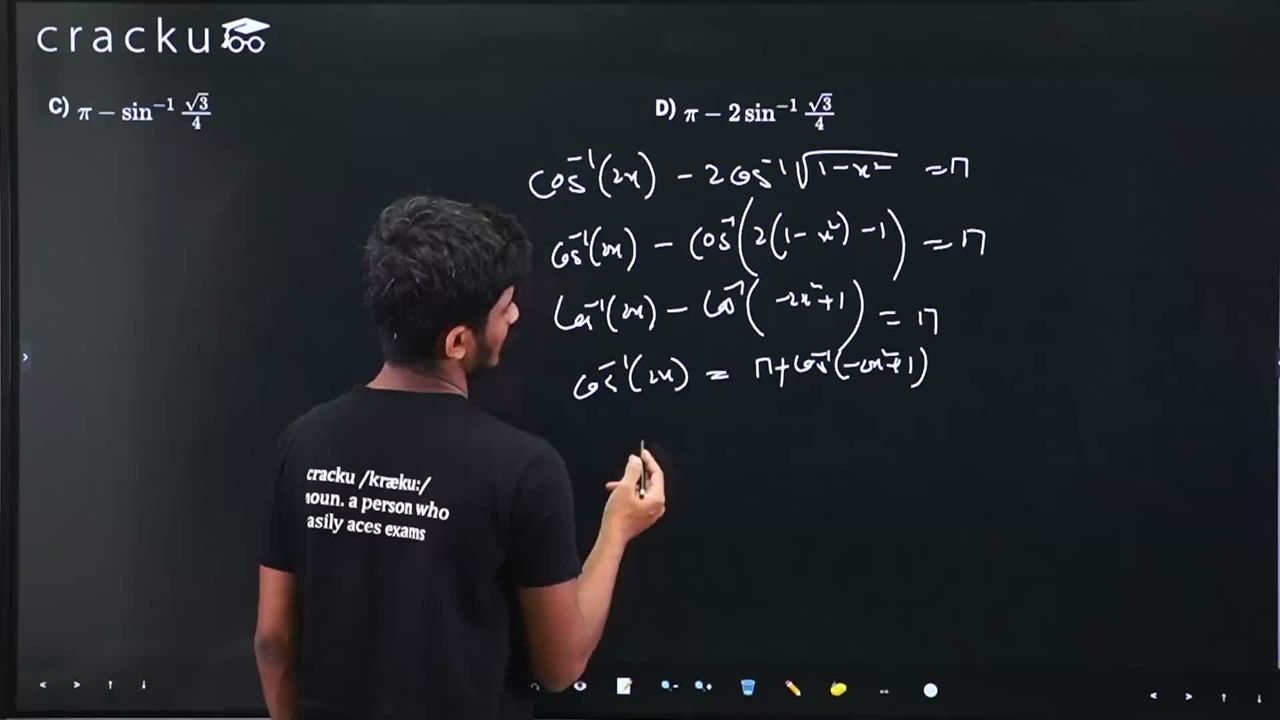
Let $$S$$ be the set of all solutions of the equation $$\cos^{-1}(2x) - 2\cos^{-1}\sqrt{1-x^2} = \pi$$, $$x \in [-\frac{1}{2}, \frac{1}{2}]$$. Then $$\sum_{x \in S} 2\sin^{-1}(x^2 - 1)$$ is equal to
We need to find all solutions of $$\cos^{-1}(2x) - 2\cos^{-1}\sqrt{1-x^2} = \pi$$ for $$x \in \left[-\frac{1}{2}, \frac{1}{2}\right]$$, and then evaluate $$\sum_{x \in S} 2\sin^{-1}(x^2 - 1)$$.
Determine the ranges of each term.
For $$x \in [-1/2, 1/2]$$:
- $$2x \in [-1, 1]$$, so $$\cos^{-1}(2x) \in [0, \pi]$$
- $$1 - x^2 \in [3/4, 1]$$, so $$\sqrt{1-x^2} \in [\sqrt{3}/2, 1]$$
- $$\cos^{-1}\sqrt{1-x^2} \in [0, \pi/6]$$
- Therefore $$2\cos^{-1}\sqrt{1-x^2} \in [0, \pi/3]$$
Analyze whether the equation can be satisfied.
The left-hand side equals:
$$ \text{LHS} = \cos^{-1}(2x) - 2\cos^{-1}\sqrt{1-x^2} $$
The maximum possible value of the LHS is achieved when $$\cos^{-1}(2x)$$ is maximum (= $$\pi$$, when $$x = -1/2$$) and $$2\cos^{-1}\sqrt{1-x^2}$$ is minimum (= 0, when $$x = 0$$). But these cannot occur simultaneously since $$x$$ cannot be both $$-1/2$$ and $$0$$.
Check specific values.
At $$x = -1/2$$:
$$ \cos^{-1}(2 \times (-1/2)) = \cos^{-1}(-1) = \pi $$
$$ \sqrt{1 - 1/4} = \sqrt{3}/2, \quad \cos^{-1}(\sqrt{3}/2) = \pi/6 $$
$$ \text{LHS} = \pi - 2 \times \pi/6 = \pi - \pi/3 = 2\pi/3 \neq \pi $$
At $$x = 0$$:
$$ \cos^{-1}(0) = \pi/2, \quad \sqrt{1-0} = 1, \quad \cos^{-1}(1) = 0 $$
$$ \text{LHS} = \pi/2 - 0 = \pi/2 \neq \pi $$
Show the LHS is always less than $$\pi$$.
Since $$\cos^{-1}(2x) \leq \pi$$ and $$2\cos^{-1}\sqrt{1-x^2} \geq 0$$, we have $$\text{LHS} \leq \pi$$. For equality, we need $$\cos^{-1}(2x) = \pi$$ (i.e., $$x = -1/2$$) AND $$\cos^{-1}\sqrt{1-x^2} = 0$$ (i.e., $$x = 0$$) simultaneously, which is impossible.
Moreover, at $$x = -1/2$$ (where the first term is maximized), the second term equals $$\pi/3 > 0$$, so $$\text{LHS} = \pi - \pi/3 = 2\pi/3 < \pi$$. Since the LHS is continuous and never reaches $$\pi$$, the equation has no solution in the given domain.
Evaluate the required sum.
Since the solution set $$S$$ is empty:
$$ \sum_{x \in S} 2\sin^{-1}(x^2 - 1) = 0 $$
The correct answer is Option 1: 0.
Was this solution helpful?
Click on the Email ☝️ to Watch the Video Solution
Create a FREE account and get:
_1.webp)

Educational materials for JEE preparation

Ask our AI anything

AI can make mistakes. Please verify important information.
AI can make mistakes. Please verify important information.
