
Join Our JEE Preparation Group
Prep with like-minded aspirants; Get access to free daily tests and study material.
Sign in
Please select an account to continue using cracku.in
↓ →
Join Our JEE Preparation Group
Prep with like-minded aspirants; Get access to free daily tests and study material.
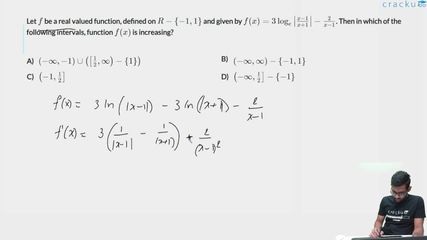
Let $$f$$ be a real valued function, defined on $$R - \{-1, 1\}$$ and given by $$f(x) = 3\log_e\left|\frac{x-1}{x+1}\right| - \frac{2}{x-1}$$. Then in which of the following intervals, function $$f(x)$$ is increasing?
We have $$f(x) = 3\ln\left|\frac{x-1}{x+1}\right| - \frac{2}{x-1}$$, defined on $$\mathbb{R} \setminus \{-1, 1\}$$.
Differentiating: $$f'(x) = 3\left(\frac{1}{x-1} - \frac{1}{x+1}\right) + \frac{2}{(x-1)^2} = \frac{3}{x-1} - \frac{3}{x+1} + \frac{2}{(x-1)^2}$$.
Taking the common denominator $$(x-1)^2(x+1)$$:
$$f'(x) = \frac{3(x-1)(x+1) - 3(x-1)^2 + 2(x+1)}{(x-1)^2(x+1)}$$
Expanding the numerator: $$3(x^2 - 1) - 3(x^2 - 2x + 1) + 2(x + 1) = 3x^2 - 3 - 3x^2 + 6x - 3 + 2x + 2 = 8x - 4 = 4(2x - 1)$$.
So $$f'(x) = \frac{4(2x-1)}{(x-1)^2(x+1)}$$. Since $$(x-1)^2 > 0$$ for $$x \neq 1$$, the sign of $$f'(x)$$ depends on $$\frac{2x-1}{x+1}$$.
$$f'(x) \geq 0$$ when $$\frac{2x-1}{x+1} \geq 0$$, which happens when both factors are non-negative or both non-positive:
Case 1: $$2x - 1 \geq 0$$ and $$x + 1 > 0$$, i.e., $$x \geq \frac{1}{2}$$ (with $$x \neq 1$$).
Case 2: $$2x - 1 \leq 0$$ and $$x + 1 < 0$$, i.e., $$x < -1$$.
Therefore, $$f(x)$$ is increasing on $$(-\infty, -1) \cup \left[\frac{1}{2}, \infty\right) \setminus \{1\}$$.
Was this solution helpful?
Click on the Email ☝️ to Watch the Video Solution
Create a FREE account and get:
_1.webp)

Educational materials for JEE preparation

Ask our AI anything

AI can make mistakes. Please verify important information.
AI can make mistakes. Please verify important information.
