
Join Our JEE Preparation Group
Prep with like-minded aspirants; Get access to free daily tests and study material.
Sign in
Please select an account to continue using cracku.in
↓ →
Join Our JEE Preparation Group
Prep with like-minded aspirants; Get access to free daily tests and study material.
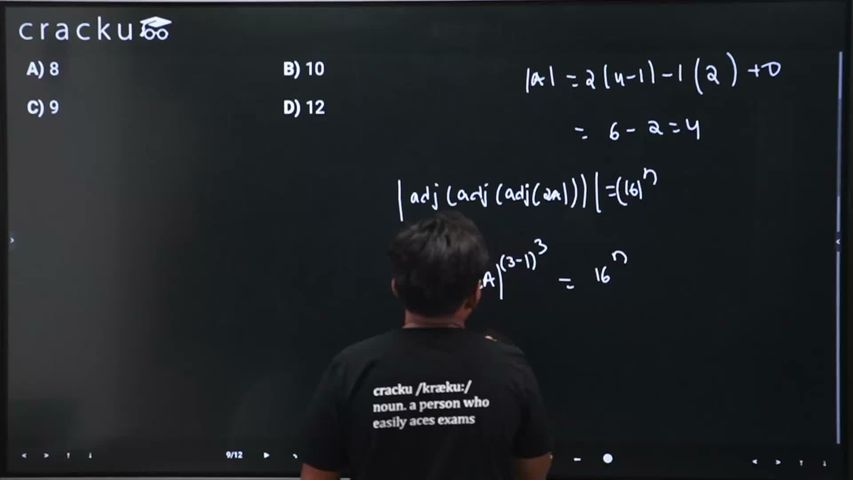
Let $$\begin{bmatrix} 2 & 1 & 0 \\ 1 & 2 & -1 \\ 0 & -1 & 2 \end{bmatrix}$$. If $$|adj(adj(adj(2A)))| = (16)^n$$, then $$n$$ is equal to
To solve this quickly, use the properties of determinants and adjoints for an $$n \times n$$ matrix (here, $$m = 3$$):
Expand the determinant of $$A$$:
$$|A| = 2(4 - 1) - 1(2 - 0) + 0 = 2(3) - 2 = 4$$
For a $$3 \times 3$$ matrix, $$|kA| = k^3|A|$$:
$$|2A| = 2^3 \cdot 4 = 8 \cdot 4 = 32 = 2^5$$
The formula for $$|\text{adj}(\text{adj}(\dots(\text{adj}(M))\dots))|$$ with $$k$$ adjoints is $$|M|^{(m-1)^k}$$.
Here, $$k = 3$$ (three adjoints) and $$m = 3$$:
$$| \text{adj}(\text{adj}(\text{adj}(2A))) | = |2A|^{(3-1)^3} = |2A|^{2^3} = |2A|^8$$
Substitute the value of $$|2A|$$:
$$(2^5)^8 = 2^{40}$$
The problem states this equals $$(16)^n$$:
$$(2^4)^n = 2^{4n}$$
Equating powers:
$$4n = 40 \implies n = 10$$
Was this solution helpful?
Click on the Email ☝️ to Watch the Video Solution
Create a FREE account and get:
_1.webp)

Educational materials for JEE preparation

Ask our AI anything

AI can make mistakes. Please verify important information.
AI can make mistakes. Please verify important information.
