
Join Our JEE Preparation Group
Prep with like-minded aspirants; Get access to free daily tests and study material.
Sign in
Please select an account to continue using cracku.in
↓ →
Join Our JEE Preparation Group
Prep with like-minded aspirants; Get access to free daily tests and study material.
$$KMnO_4$$ acts as an oxidising agent in acidic medium. 'X' is the difference between the oxidation states of Mn in reactant and product. 'Y' is the number of 'd' electrons present in the brown red precipitate formed at the end of the acetate ion test with neutral ferric chloride. The value of X + Y is ________.
Correct Answer: 10
In acidic medium, the purple permanganate ion $$MnO_4^-$$ present in $$KMnO_4$$ is reduced to the colourless $$Mn^{2+}$$ ion.
Step 1 - Oxidation state of Mn in the reactant:
In $$MnO_4^-$$ let the oxidation state of Mn be $$x$$. Using $$O$$ in state $$-2$$:
$$x + 4(-2) = -1 \;\;\Rightarrow\;\; x - 8 = -1 \;\;\Rightarrow\;\; x = +7$$
Step 2 - Oxidation state of Mn in the product:
In $$Mn^{2+}$$ the oxidation state is $$+2$$.
Step 3 - Difference $$X$$ between the two oxidation states:
$$X = 7 - 2 = 5$$
Step 4 - Brown-red precipitate in the acetate test:
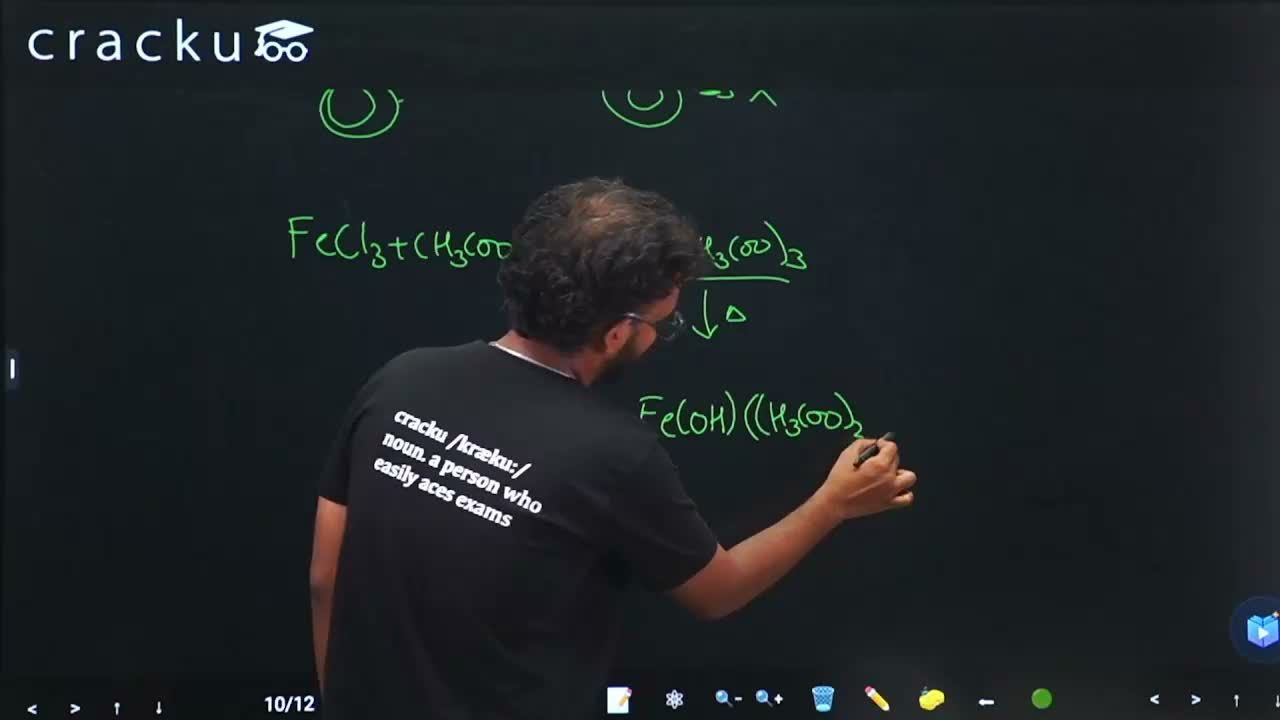
On adding neutral $$FeCl_3$$ to an acetate solution, deep-red $$Fe(CH_3COO)_3$$ is first formed. On boiling it hydrolyses to a brown-red basic ferric acetate, commonly written as $$Fe(OH)(CH_3COO)_2$$. In both species iron is in the $$+3$$ oxidation state, i.e. present as $$Fe^{3+}$$.
Electronic configuration of $$Fe$$: $$[Ar]\,3d^6\,4s^2$$.
For $$Fe^{3+}$$ three electrons are removed (first the two 4s, then one 3d):
$$Fe^{3+} : [Ar]\,3d^5$$
Step 5 - Number of $$d$$ electrons $$Y$$ in $$Fe^{3+}$$:
$$Y = 5$$
Step 6 - Required sum:
$$X + Y = 5 + 5 = 10$$
Therefore, the value of $$X + Y$$ is $$10$$.
Was this solution helpful?
Click on the Email ☝️ to Watch the Video Solution
Create a FREE account and get:
_1.webp)

Educational materials for JEE preparation

Ask our AI anything

AI can make mistakes. Please verify important information.
AI can make mistakes. Please verify important information.
