
Join Our JEE Preparation Group
Prep with like-minded aspirants; Get access to free daily tests and study material.
Sign in
Please select an account to continue using cracku.in
↓ →
Join Our JEE Preparation Group
Prep with like-minded aspirants; Get access to free daily tests and study material.
For the following reaction at 50 °C and at 2 atm pressure,
$$2N_2O_5(g) \rightleftharpoons 2N_2O_4(g) + O_2(g)$$
N$$_2$$O$$_5$$ is 50% dissociated.
The magnitude of standard free energy change at this temperature is $$x$$.
$$x$$ = _________ J mol$$^{-1}$$ [Nearest integer].
Given: $$R = 8.314$$ J mol$$^{-1}$$ K$$^{-1}$$, $$\log 2 = 0.30$$, $$\log 3 = 0.48$$, $$\ln 10 = 2.303$$, °C + 273 = K
Correct Answer: 2461
For the equilibrium
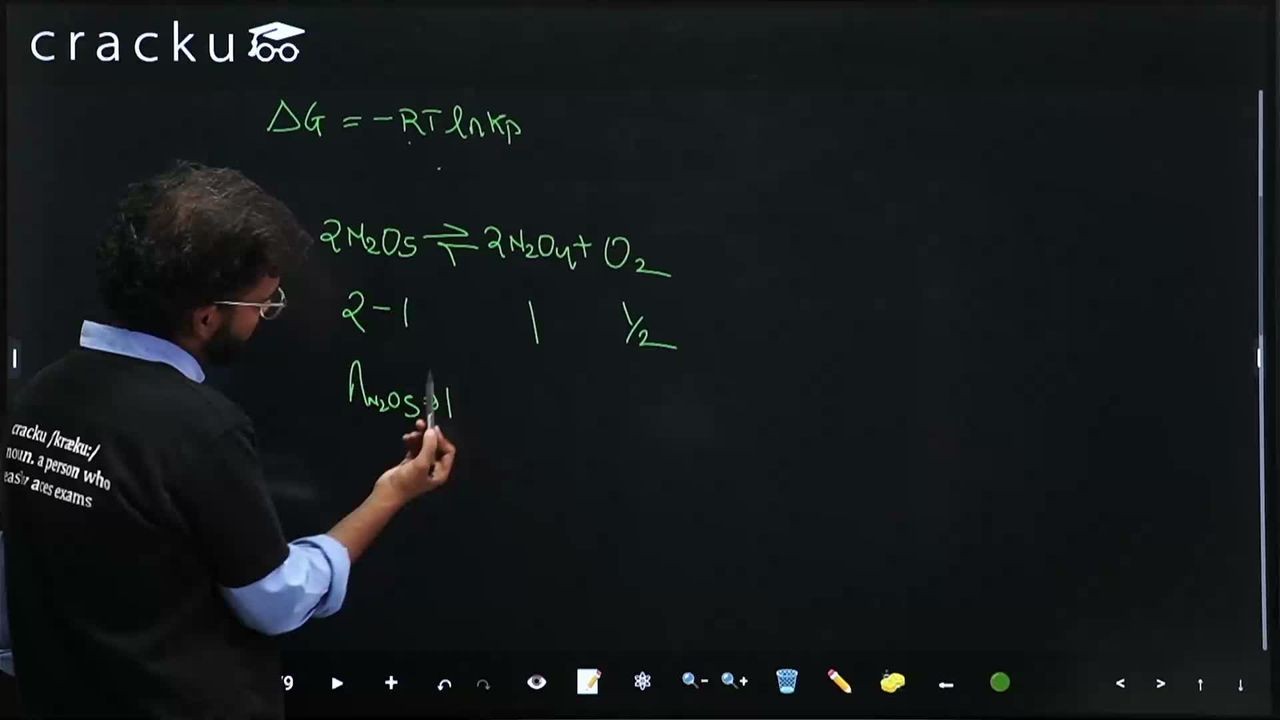
$$2\,\text{N}_2\text{O}_5(g)\;\rightleftharpoons\;2\,\text{N}_2\text{O}_4(g)\;+\;\text{O}_2(g)$$
let us start with $$2$$ mol of $$\text{N}_2\text{O}_5$$ (this matches the stoichiometric coefficient).
Extent of dissociation
Given 50 % dissociation, exactly $$1$$ mol of the initial $$2$$ mol reacts.
Using the stoichiometry $$2\text{N}_2\text{O}_5 \rightarrow 2\text{N}_2\text{O}_4 + \text{O}_2$$:
• $$\text{N}_2\text{O}_5$$ left = $$2 - 1 = 1$$ mol
• $$\text{N}_2\text{O}_4$$ formed = $$1 \times \frac{2}{2} = 1$$ mol
• $$\text{O}_2$$ formed = $$1 \times \frac{1}{2} = 0.5$$ mol
Total moles at equilibrium
$$n_{\text{tot}} = 1 + 1 + 0.5 = 2.5\ \text{mol}$$
The total pressure is given as $$P = 2\ \text{atm}$$, so the partial pressures are
$$P_{\text{N}_2\text{O}_5} = \frac{1}{2.5}\times 2 = 0.8\ \text{atm}$$
$$P_{\text{N}_2\text{O}_4} = \frac{1}{2.5}\times 2 = 0.8\ \text{atm}$$
$$P_{\text{O}_2} = \frac{0.5}{2.5}\times 2 = 0.4\ \text{atm}$$
Equilibrium constant $$K_p$$
For the reaction
$$2\text{N}_2\text{O}_5 \rightleftharpoons 2\text{N}_2\text{O}_4 + \text{O}_2$$
$$K_p = \frac{(P_{\text{N}_2\text{O}_4})^{2}\; P_{\text{O}_2}}{(P_{\text{N}_2\text{O}_5})^{2}}$$
Substituting the calculated partial pressures
$$K_p = \frac{(0.8)^2 \times 0.4}{(0.8)^2} = 0.4$$
Standard Gibbs free-energy change
The relation between $$\Delta G^{\circ}$$ and $$K_p$$ is
$$\Delta G^{\circ} = -RT\ln K_p$$
Temperature: $$T = 50^{\circ}\text{C} = 323\ \text{K}$$
Gas constant: $$R = 8.314\ \text{J mol}^{-1}\text{K}^{-1}$$
First find $$\ln 0.4$$.
Using base-10 logs provided:
$$\log_{10}0.4 = \log_{10}4 - 1 = 0.602 - 1 = -0.398$$
Convert to natural log:
$$\ln 0.4 = 2.303 \times (-0.398) \approx -0.916$$
Now compute $$\Delta G^{\circ}$$:
$$\Delta G^{\circ} = -(8.314)(323)(-0.916)$$
$$\quad\; = 8.314 \times 323 \times 0.916$$
$$\quad\; \approx 2685.4 \times 0.916 \approx 2.46 \times 10^{3}\ \text{J mol}^{-1}$$
Hence
$$|\Delta G^{\circ}| \approx 2461\ \text{J mol}^{-1}$$ (nearest integer).
Answer: 2461
Was this solution helpful?
Click on the Email ☝️ to Watch the Video Solution
Create a FREE account and get:
_1.webp)

Educational materials for JEE preparation

Ask our AI anything

AI can make mistakes. Please verify important information.
AI can make mistakes. Please verify important information.


