
Join Our JEE Preparation Group
Prep with like-minded aspirants; Get access to free daily tests and study material.
Sign in
Please select an account to continue using cracku.in
↓ →
Join Our JEE Preparation Group
Prep with like-minded aspirants; Get access to free daily tests and study material.
Consider the following electrochemical cell at standard condition.
$$Au(s)|QH_2,Q|NH_4X(0.01M)||Ag^+(1M)|Ag(s)$$
$$E_{cell} = +0.4V$$
The couple $$QH_2/Q$$ represents quinhydrone electrode, the half cell reaction is given below:
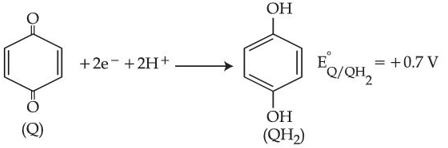
[Given: $$E^o_{Ag^+/Ag} = +0.8V$$ and $$\frac{2.303RT}{F} = 0.06V$$]
The $$pK_b$$ value of the ammonium halide salt ($$NH_4X$$) used here is ______. (nearest integer)
Correct Answer: 6
The quinhydrone electrode acts as the anode and the silver electrode acts as the cathode.
Anode reaction
$$QH_2 \rightarrow Q+2H^++2e^-$$
$$E^\circ_{Q/QH_2}=+0.7\text{ V}$$
Cathode reaction
$$2Ag^++2e^- \rightarrow 2Ag$$
$$E^\circ_{Ag^+/Ag}=+0.8\text{ V}$$
The standard cell potential is
$$E^\circ_{cell}=E^\circ_{cathode}-E^\circ_{anode}$$
$$E^\circ_{cell}=0.8-0.7=0.1\text{ V}$$
The overall cell reaction is
$$QH_2+2Ag^+ \rightarrow Q+2H^++2Ag$$
For the quinhydrone electrode, $$[Q]=[QH_2]$$, therefore they cancel out in the reaction quotient. Also, $$[Ag^+]=1\text{ M}$$.
The Nernst equation becomes
$$E_{cell}=E^\circ_{cell}-\frac{0.06}{2}\log[H^+]^2$$
Substituting the given values,
$$0.4=0.1-0.03\log[H^+]^2$$
$$0.4=0.1-0.06\log[H^+]$$
Since
$$pH=-\log[H^+]$$
we get
$$0.4=0.1+0.06(pH)$$
$$0.3=0.06(pH)$$
$$pH=5$$
The solution in the anodic compartment contains $$NH_4X$$, a salt of a weak base and a strong acid.
For such a salt,
$$pH=7-\frac{1}{2}pK_b-\frac{1}{2}\log C$$
Given,
$$pH=5$$
$$C=0.01\text{ M}=10^{-2}\text{ M}$$
Substituting,
$$5=7-\frac{1}{2}pK_b-\frac{1}{2}\log(10^{-2})$$
$$5=7-\frac{1}{2}pK_b+1$$
$$5=8-\frac{1}{2}pK_b$$
$$\frac{1}{2}pK_b=3$$
$$pK_b=6$$
Therefore,
$$\boxed{pK_b=6}$$
Was this solution helpful?
Create a FREE account and get:
_1.webp)

Educational materials for JEE preparation

Ask our AI anything

AI can make mistakes. Please verify important information.
AI can make mistakes. Please verify important information.


