
Join Our JEE Preparation Group
Prep with like-minded aspirants; Get access to free daily tests and study material.
Sign in
Please select an account to continue using cracku.in
↓ →
Join Our JEE Preparation Group
Prep with like-minded aspirants; Get access to free daily tests and study material.
X g of nitrobenzene on nitration gave 4.2 g of m-dinitrobenzene. X = ________ g. (nearest integer)
[Given: molar mass (in g mol$$^{-1}$$) C: 12, H: 1, O: 16, N: 14]
Correct Answer: 3
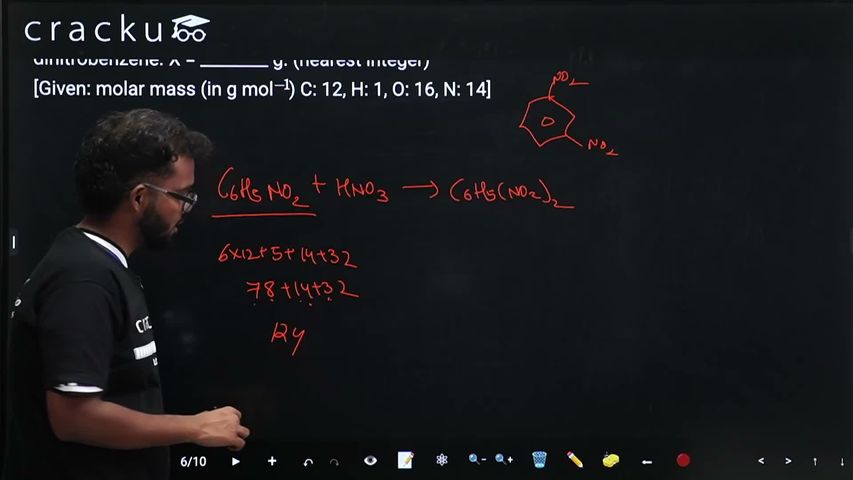
For the conversion of nitrobenzene to m-dinitrobenzene, the nitration reaction is:
$$C_6H_5NO_2 + HNO_3 \rightarrow C_6H_4(NO_2)_2 + H_2O$$
This shows a $$1{:}1$$ molar ratio between nitrobenzene and m-dinitrobenzene.
Step 1: Calculate the molar mass of nitrobenzene, $$C_6H_5NO_2$$.
$$M_{\text{nitrobenzene}} = 6(12) + 5(1) + 1(14) + 2(16) = 72 + 5 + 14 + 32 = 123\ \text{g mol}^{-1}$$
Step 2: Calculate the molar mass of m-dinitrobenzene, $$C_6H_4(NO_2)_2$$.
$$M_{\text{dinitro}} = 6(12) + 4(1) + 2(14) + 4(16) = 72 + 4 + 28 + 64 = 168\ \text{g mol}^{-1}$$
Step 3: Use the stoichiometric mass ratio.
$$123\ \text{g nitrobenzene} \longrightarrow 168\ \text{g dinitrobenzene}$$
Step 4: For a yield of $$4.2\ \text{g}$$ of m-dinitrobenzene, the required mass of nitrobenzene is
$$X = 4.2 \times \frac{123}{168}\ \text{g}$$
$$X = 4.2 \times 0.7321\ (\text{since }123/168 = 0.7321)$$
$$X = 3.075\ \text{g}$$
Step 5: Rounding to the nearest integer:
$$X \approx 3\ \text{g}$$
Hence, the required mass of nitrobenzene is $$\mathbf{3\ g}$$.
Click on the Email ☝️ to Watch the Video Solution
Create a FREE account and get:
_1.webp)

Educational materials for JEE preparation

Ask our AI anything

AI can make mistakes. Please verify important information.
AI can make mistakes. Please verify important information.


