
Join Our JEE Preparation Group
Prep with like-minded aspirants; Get access to free daily tests and study material.
Sign in
Please select an account to continue using cracku.in
↓ →
Join Our JEE Preparation Group
Prep with like-minded aspirants; Get access to free daily tests and study material.
The first of the two samples in a group has 100 items with mean 15 and standard deviation 3. If the whole group has 250 items with mean 15.6 and standard deviation $$\sqrt{13.44}$$, then the standard deviation of the second sample is:
Let us denote the size, mean and standard deviation of the first sample by $$n_1,\;\mu_1,\;\sigma_1$$ and of the second sample by $$n_2,\;\mu_2,\;\sigma_2.$$ The symbols $$n,\;\mu,\;\sigma$$ will represent the corresponding quantities for the whole group.
We have for the first sample $$n_1 = 100,\;\mu_1 = 15,\;\sigma_1 = 3.$$ Therefore the variance of the first sample is $$\sigma_1^{2} = 3^{2} = 9.$$
The whole group consists of $$n = 250$$ items with mean $$\mu = 15.6$$ and standard deviation $$\sigma = \sqrt{13.44},$$ so the variance of the whole group is $$\sigma^{2} = 13.44.$$
Because the whole group contains 250 items and the first sample contains 100 items, the second sample must contain
$$n_2 = n - n_1 = 250 - 100 = 150$$
items.
First, we compute the mean of the second sample. The formula for the combined mean of two groups is
$$\mu = \frac{n_1\mu_1 + n_2\mu_2}{n_1 + n_2}.$$
Solving this for $$\mu_2$$ gives
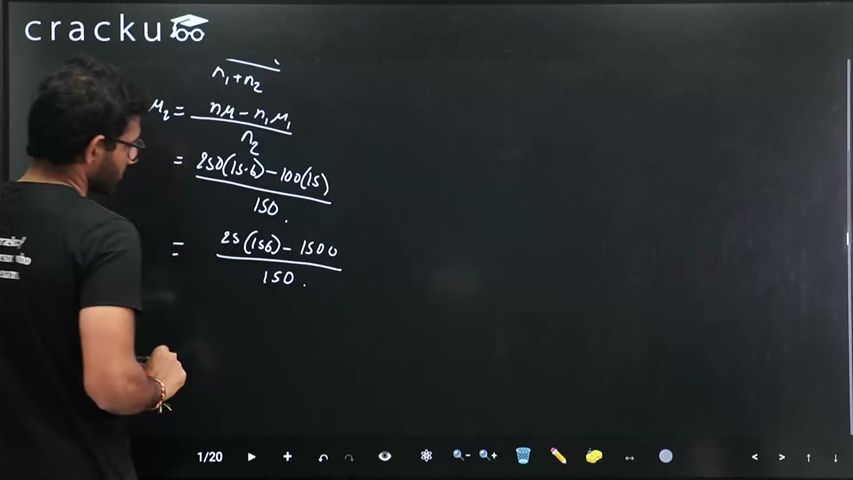
$$\mu_2 = \frac{(n_1 + n_2)\mu - n_1\mu_1}{n_2}.$$
Substituting the known numbers, we obtain
$$\mu_2 = \frac{250 \times 15.6 - 100 \times 15}{150} = \frac{3900 - 1500}{150} = \frac{2400}{150} = 16.$$
Now we move to the variance. The formula that expresses the variance of the combined group in terms of the variances and means of the two sub-groups is
$$\sigma^{2} \;=\; \frac{n_1\bigl[\sigma_1^{2} + (\mu_1 - \mu)^{2}\bigr] \;+\; n_2\bigl[\sigma_2^{2} + (\mu_2 - \mu)^{2}\bigr]} {n_1 + n_2}.$$
We already know $$\sigma^{2} = 13.44,$$ so we substitute every known quantity and keep $$\sigma_2^{2}$$ as the unknown.
First compute the bracket for the first sample:
$$\sigma_1^{2} + (\mu_1 - \mu)^{2} = 9 + (15 - 15.6)^{2} = 9 + (-0.6)^{2} = 9 + 0.36 = 9.36.$$
Multiplying by $$n_1$$ gives
$$n_1\bigl[\sigma_1^{2} + (\mu_1 - \mu)^{2}\bigr] = 100 \times 9.36 = 936.$$
Next, form the bracket for the second sample, leaving $$\sigma_2^{2}$$ unknown:
$$\sigma_2^{2} + (\mu_2 - \mu)^{2} = \sigma_2^{2} + (16 - 15.6)^{2} = \sigma_2^{2} + 0.4^{2} = \sigma_2^{2} + 0.16.$$
Multiplying by $$n_2$$ gives
$$n_2\bigl[\sigma_2^{2} + (\mu_2 - \mu)^{2}\bigr] = 150\bigl(\sigma_2^{2} + 0.16\bigr) = 150\sigma_2^{2} + 24.$$
Putting all these into the combined variance formula, we get
$$13.44 = \frac{936 + 150\sigma_2^{2} + 24}{250}.$$
Simplify the numerator inside the fraction:
$$936 + 24 = 960,$$
so the equation becomes
$$13.44 = \frac{960 + 150\sigma_2^{2}}{250}.$$
Now multiply both sides by 250 to clear the denominator:
$$13.44 \times 250 = 960 + 150\sigma_2^{2}.$$
Calculating the left-hand product, we get
$$13.44 \times 250 = 3360,$$
so
$$3360 = 960 + 150\sigma_2^{2}.$$
Subtract 960 from both sides:
$$3360 - 960 = 150\sigma_2^{2},$$
$$2400 = 150\sigma_2^{2}.$$
Finally, divide by 150:
$$\sigma_2^{2} = \frac{2400}{150} = 16.$$
The variance of the second sample is therefore $$16,$$ and its standard deviation is the square root of this value:
$$\sigma_2 = \sqrt{16} = 4.$$
Hence, the correct answer is Option C.
Was this solution helpful?
Click on the Email ☝️ to Watch the Video Solution
Create a FREE account and get:
_1.webp)

Educational materials for JEE preparation

Ask our AI anything

AI can make mistakes. Please verify important information.
AI can make mistakes. Please verify important information.
