
Join Our JEE Preparation Group
Prep with like-minded aspirants; Get access to free daily tests and study material.
Sign in
Please select an account to continue using cracku.in
↓ →
Join Our JEE Preparation Group
Prep with like-minded aspirants; Get access to free daily tests and study material.
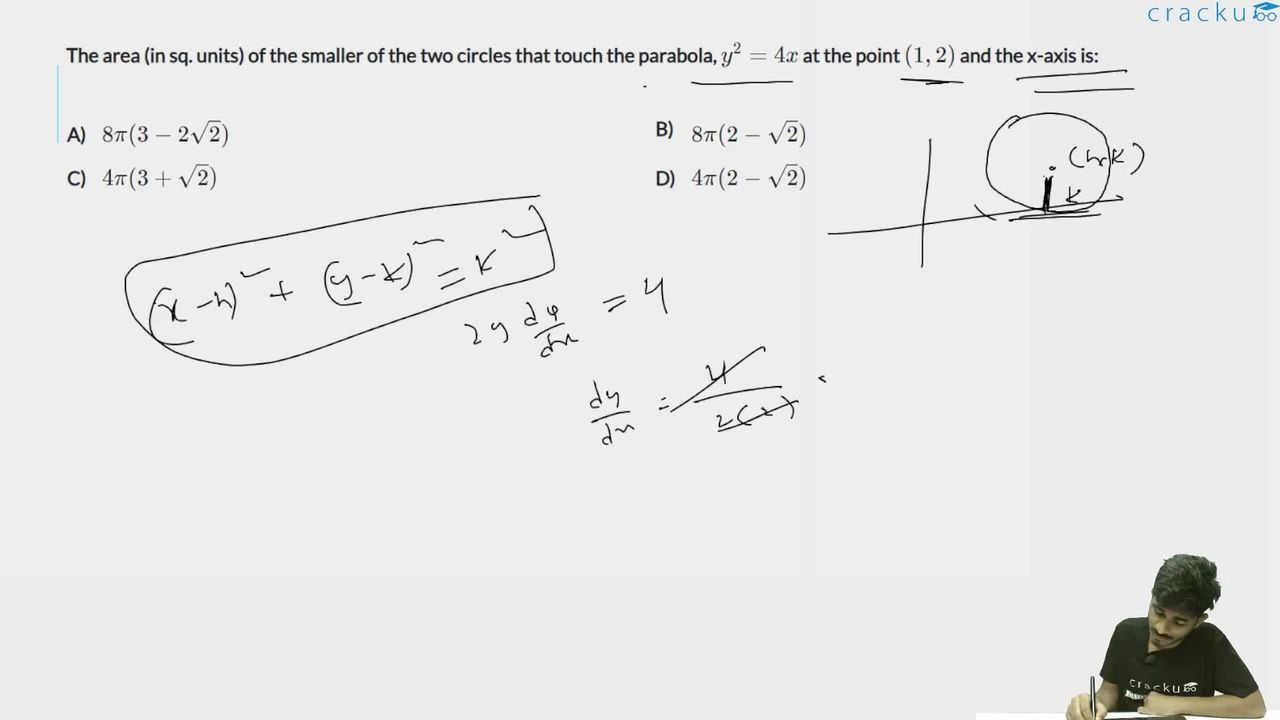
The area (in sq. units) of the smaller of the two circles that touch the parabola, $$y^2 = 4x$$ at the point $$(1, 2)$$ and the x-axis is:
We are given the parabola $$y^{2}=4x$$ and the fixed point of contact $$(1,2)$$. A circle touching the x-axis must have its centre directly above (or below) the point of tangency on the x-axis, so if the centre is $$(h,k)$$ and the radius is $$r$$, we must have $$k=r$$ (because the vertical distance from the centre to the x-axis equals the radius).
The circle also passes through $$(1,2)$$, hence we must satisfy the distance formula
$$ (1-h)^{2}+(2-k)^{2}=r^{2}. \quad -(1) $$
To ensure tangency with the parabola at $$(1,2)$$, the circle and the parabola must share the same tangent line there. Let us first find the tangent to the parabola at that point.
Differentiating $$y^{2}=4x$$ with respect to $$x$$ gives $$ 2y\frac{dy}{dx}=4 \quad\Longrightarrow\quad \frac{dy}{dx}=\frac{2}{y}. $$ At $$(1,2)$$ we have $$\displaystyle\frac{dy}{dx}=\frac{2}{2}=1,$$ so the tangent line is $$ y-2 = 1(x-1)\;\Longrightarrow\; y = x+1. $$
For any circle, the radius drawn to the point of tangency is perpendicular to the tangent line. The slope of the tangent is $$1$$, hence the slope of the radius is $$-1.$$ Therefore
$$ \frac{2-k}{\,1-h\,} = -1. \quad -(2) $$
Because $$k=r$$, equation (2) becomes $$ 2-r = -(1-h) \; \Longrightarrow \; 2-r = -1 + h \; \Longrightarrow \; h+r = 3. \quad -(3) $$
Now substitute $$k=r$$ and $$h = 3-r$$ from (3) into the distance condition (1):
$$ (1-(3-r))^{2} + (2-r)^{2} = r^{2}. $$
Simplifying each term, we note that $$1-(3-r)=r-2,$$ hence $$ (r-2)^{2} + (2-r)^{2} = r^{2}. $$ But $$(2-r)^{2}=(r-2)^{2},$$ so we obtain $$ 2(r-2)^{2}=r^{2}. $$
Expanding and collecting terms,
$$ 2(r^{2}-4r+4)=r^{2} \quad\Longrightarrow\quad 2r^{2}-8r+8=r^{2}. $$
Bringing everything to one side,
$$ r^{2}-8r+8=0. $$
This quadratic equation gives $$ r = \frac{8\pm\sqrt{64-32}}{2} = \frac{8\pm4\sqrt{2}}{2} = 4 \pm 2\sqrt{2}. $$
Both roots are positive, so two circles exist. The smaller circle has
$$ r = 4-2\sqrt{2}. $$
Its area is therefore $$ \text{Area} = \pi r^{2} = \pi\bigl(4-2\sqrt{2}\bigr)^{2}. $$
Expanding the square, $$ (4-2\sqrt{2})^{2}=4^{2}-2\!\times\!4\!\times\!2\sqrt{2}+(2\sqrt{2})^{2}=16-16\sqrt{2}+8=24-16\sqrt{2}. $$
Factoring the common $$8$$ we have $$ 24-16\sqrt{2}=8(3-2\sqrt{2}). $$
Hence $$ \text{Area}= \pi \times 8(3-2\sqrt{2}) = 8\pi(3-2\sqrt{2}). $$
Hence, the correct answer is Option A.
Was this solution helpful?
Click on the Email ☝️ to Watch the Video Solution
Create a FREE account and get:
_1.webp)

Educational materials for JEE preparation

Ask our AI anything

AI can make mistakes. Please verify important information.
AI can make mistakes. Please verify important information.


