
Join Our JEE Preparation Group
Prep with like-minded aspirants; Get access to free daily tests and study material.
Sign in
Please select an account to continue using cracku.in
↓ →
Join Our JEE Preparation Group
Prep with like-minded aspirants; Get access to free daily tests and study material.
The common tangent to the circles $$x^2 + y^2 = 4$$ and $$x^2 + y^2 + 6x + 8y - 24 = 0$$ also passes through the point:
We have two circles.
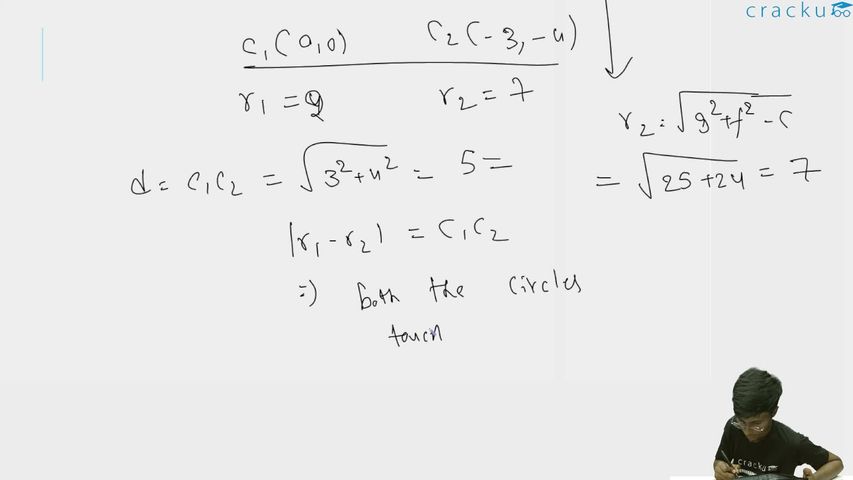
The first circle is given by $$x^2+y^2=4$$. Comparing with the standard form $$(x-h)^2+(y-k)^2=r^2,$$ we see that its centre is $$C_1(0,0)$$ and its radius is $$r_1=2.$$
The second circle is $$x^2+y^2+6x+8y-24=0.$$ To locate its centre and radius we complete squares:
$$\begin{aligned} x^2+6x+y^2+8y &= 24 \\[4pt] (x^2+6x+9)+(y^2+8y+16) &= 24+9+16 \\[4pt] (x+3)^2+(y+4)^2 &= 49. \end{aligned}$$
Thus the centre of the second circle is $$C_2(-3,-4)$$ and its radius is $$r_2=7.$$
We now look for a straight line that is tangent to both circles. Let its equation in slope-intercept form be
$$y=mx+c.$$
For any circle, a line $$y=mx+c$$ is tangent if the perpendicular distance from the centre to the line equals the radius. The perpendicular distance from $$(x_0,y_0)$$ to $$y=mx+c$$ is
$$\frac{|y_0-mx_0-c|}{\sqrt{1+m^2}}.$$
Applying this to the first circle with centre $$C_1(0,0)$$, we get
$$\frac{|\,0-0-c|}{\sqrt{1+m^2}} = r_1 = 2,$$ so $$|c| = 2\sqrt{1+m^2}.$$
Hence $$c=\pm 2\sqrt{1+m^2}.$$ We keep the symbol $$R=\sqrt{1+m^2} \quad(\,R\gt 0\,)$$ to shorten our calculations.
Next we impose the tangency condition for the second circle. The perpendicular distance from $$C_2(-3,-4)$$ to $$y=mx+c$$ must equal $$r_2=7$$:
$$\frac{|\,(-4)-m(-3)-c|}{\sqrt{1+m^2}} = 7 \;\Longrightarrow\; |\, -4+3m-c| = 7R.$$
We consider the two possible values of $$c$$ separately.
(i) Taking $$c=2R$$
The condition becomes $$|\, -4+3m-2R| = 7R.$$ Removing the absolute value gives two equations:
$$-4+3m-2R = 7R \quad\text{or}\quad -4+3m-2R = -7R.$$
Simplifying, the first yields $$3m-9R = 4,$$ and the second yields $$3m+5R = 4.$$ Carrying out the algebra (substituting $$R=\sqrt{1+m^2}$$ and squaring to remove the square root) shows that the first relation leads to no real value of $$m$$, whereas the second produces the quadratic
$$16m^2+24m+9=0.$$
The discriminant of this quadratic is $$\Delta = 24^2-4\!\cdot\!16\!\cdot\!9 = 576-576 = 0,$$ so there is one real root:
$$m = -\frac{24}{2\!\cdot\!16} = -\frac34.$$
For this value of $$m$$ we compute $$R=\sqrt{1+m^2}=\sqrt{1+\tfrac{9}{16}}=\sqrt{\tfrac{25}{16}}=\tfrac54,$$ and with $$c=2R$$ we obtain
$$c = 2\!\left(\tfrac54\right) = \tfrac52.$$
Thus the required common tangent is
$$y = -\frac34\,x + \frac52.$$
Multiplying throughout by 4 to clear fractions, we get the convenient form
$$3x + 4y - 10 = 0.$$
(ii) Taking $$c=-2R$$
A similar examination (starting with $$|\, -4+3m+2R| = 7R$$) gives no real slope, so the line found in part (i) is the only common tangent for the two circles.
We now test which of the given points satisfies the equation $$3x+4y-10=0$$:
For $$(4,-2):\;3(4)+4(-2)-10 = 12-8-10 = -6 \neq 0.$$
For $$(-4,6):\;3(-4)+4(6)-10 = -12+24-10 = 2 \neq 0.$$
For $$(6,-2):\;3(6)+4(-2)-10 = 18-8-10 = 0.$$
For $$(-6,4):\;3(-6)+4(4)-10 = -18+16-10 = -12 \neq 0.$$
Only the point $$(6,-2)$$ satisfies the equation of the common tangent.
Hence, the correct answer is Option 3.
Was this solution helpful?
Click on the Email ☝️ to Watch the Video Solution
Create a FREE account and get:
_1.webp)

Educational materials for JEE preparation

Ask our AI anything

AI can make mistakes. Please verify important information.
AI can make mistakes. Please verify important information.


