
Join Our JEE Preparation Group
Prep with like-minded aspirants; Get access to free daily tests and study material.
Sign in
Please select an account to continue using cracku.in
↓ →
Join Our JEE Preparation Group
Prep with like-minded aspirants; Get access to free daily tests and study material.
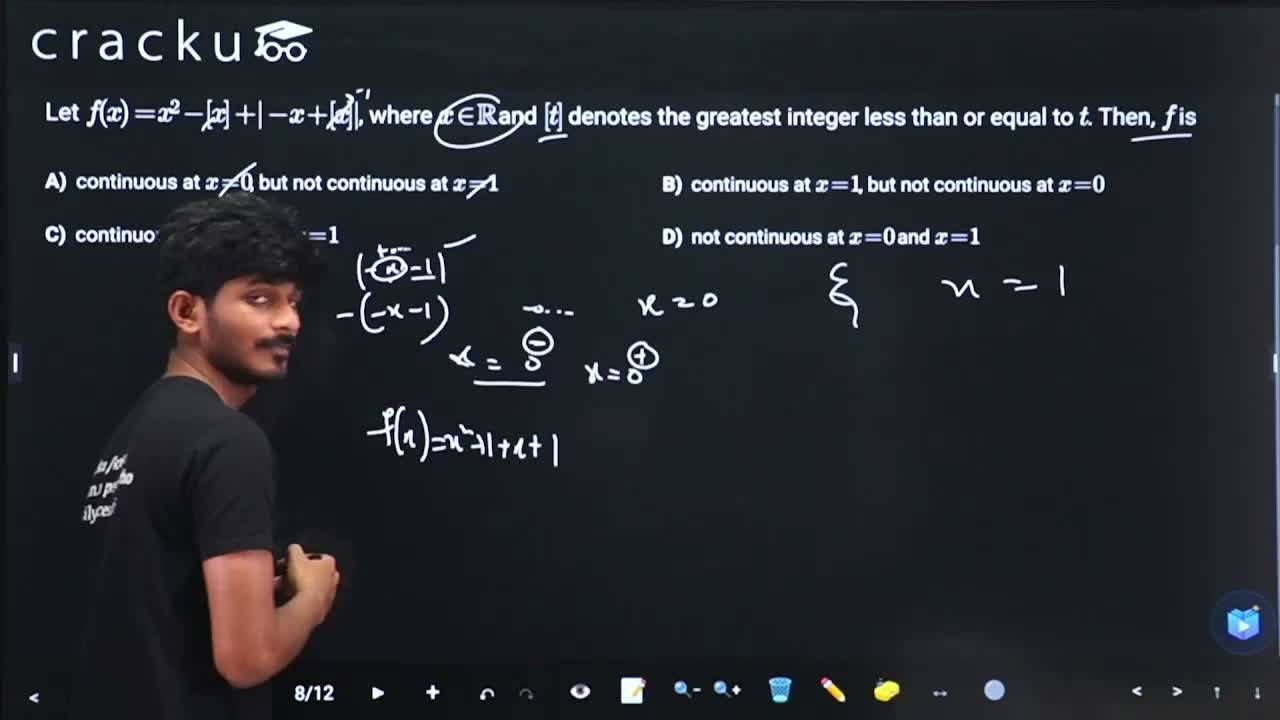
Let $$f(x) = x^2 - [x] + |-x + [x]|$$, where $$x \in \mathbb{R}$$ and $$[t]$$ denotes the greatest integer less than or equal to $$t$$. Then, $$f$$ is
Determine the continuity of $$f(x) = x^2 - [x] + |-x + [x]|$$ at $$x = 0$$ and $$x = 1$$.
Since $$x - [x] = \{x\}$$ (the fractional part, always $$\geq 0$$), we have $$|-x + [x]| = |-(x - [x])| = |\{x\}| = \{x\} = x - [x].$$ Thus $$f(x) = x^2 - [x] + (x - [x]) = x^2 + x - 2[x].$$
For $$x \in [-1, 0)$$, $$[x] = -1$$ so $$f(x) = x^2 + x + 2$$. For $$x \in [0, 1)$$, $$[x] = 0$$ so $$f(x] = x^2 + x$$. For $$x \in [1, 2)$$, $$[x] = 1$$ so $$f(x) = x^2 + x - 2$$.
At $$x = 0$$, $$f(0) = 0^2 + 0 = 0$$, $$\lim_{x \to 0^+} f(x) = 0$$, and $$\lim_{x \to 0^-} f(x) = 2$$. Since the left and right limits differ, f is not continuous at $$x = 0$$.
At $$x = 1$$, $$f(1) = 1 + 1 - 2 = 0$$, $$\lim_{x \to 1^+} f(x) = 0$$, and $$\lim_{x \to 1^-} f(x) = 2$$. Since the left limit differs from the function value, f is not continuous at $$x = 1$$.
The correct answer is Option D: not continuous at $$x = 0$$ and $$x = 1$$.
Was this solution helpful?
Click on the Email ☝️ to Watch the Video Solution
Create a FREE account and get:
_1.webp)

Educational materials for JEE preparation

Ask our AI anything

AI can make mistakes. Please verify important information.
AI can make mistakes. Please verify important information.
