 JEE WhatsApp Group
Sign in
Please select an account to continue using cracku.in
↓ →
JEE WhatsApp Group

Join Our JEE Preparation Group
Prep with like-minded aspirants; Get access to free daily tests and study material.
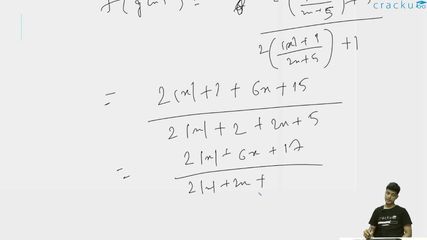
Let $$f: \mathbb{R} - \frac{-1}{2}\to \mathbb{R}$$ and $$g: \mathbb{R} - \frac{-5}{2} \to \mathbb{R}$$ be defined as $$f(x) = \frac{2x + 3}{2x + 1}$$ and $$g(x) = \frac{|x| + 1}{2x + 5}$$. Then the domain of the function fog is:
The composite function $$f\circ g$$ is defined at a real number $$x$$ when both of the following conditions are satisfied:
• $$g(x)$$ is defined (so $$x$$ lies in the domain of $$g$$).
• $$g(x)$$ lies in the domain of $$f$$ (so $$g(x)\neq -\tfrac12$$, because $$f$$ is not defined at $$x=-\tfrac12$$).
Step 1: Write the individual domains.
• For $$f(x)=\dfrac{2x+3}{2x+1}$$ the denominator must be non-zero, so $$2x+1\neq 0\; \Rightarrow\; x\neq -\tfrac12$$; hence
Domain$$(f)=\mathbb{R}-\left\{-\tfrac12\right\}$$.
• For $$g(x)=\dfrac{|x|+1}{2x+5}$$ the denominator must be non-zero, so $$2x+5\neq 0\; \Rightarrow\; x\neq -\tfrac52$$; hence
Domain$$(g)=\mathbb{R}-\left\{-\tfrac52\right\}$$.
Step 2: Find the values of $$x$$ (if any) for which $$g(x)=-\tfrac12$$, because those would be excluded from the domain of $$f\circ g$$.
Case 1: $$x\ge 0\Rightarrow |x|=x$$.
Equation: $$\frac{x+1}{2x+5}=-\frac12$$.
Cross-multiplying: $$2(x+1)=-(2x+5)\;\Rightarrow\;2x+2=-2x-5\;\Rightarrow\;4x+7=0$$.
This gives $$x=-\tfrac74$$, which is negative, contradicting $$x\ge 0$$. Hence no solution in this case.
Case 2: $$x\lt 0\Rightarrow |x|=-x$$.
Equation: $$\frac{-x+1}{2x+5}=-\frac12$$.
Cross-multiplying: $$2(-x+1)=-(2x+5)\;\Rightarrow\;-2x+2=-2x-5$$.
Adding $$2x$$ to both sides gives $$2=-5$$, which is impossible. Hence no solution in this case either.
Thus $$g(x)$$ never equals $$-\tfrac12$$ for any real $$x$$.
Step 3: Collect the restrictions.
• The only restriction from $$g$$ is $$x\neq -\tfrac52$$.
• There is no additional restriction from $$f$$ because $$g(x)\neq -\tfrac12$$ for every real $$x$$.
Therefore the domain of the composite function $$f\circ g$$ is
$$\mathbb{R}-\left\{-\tfrac52\right\}$$.
Hence the correct option is Option A.
Click on the Email ☝️ to Watch the Video Solution
Create a FREE account and get:
_1.webp)

Educational materials for JEE preparation

Ask our AI anything

AI can make mistakes. Please verify important information.
AI can make mistakes. Please verify important information.
