
Join Our JEE Preparation Group
Prep with like-minded aspirants; Get access to free daily tests and study material.
Sign in
Please select an account to continue using cracku.in
↓ →
Join Our JEE Preparation Group
Prep with like-minded aspirants; Get access to free daily tests and study material.
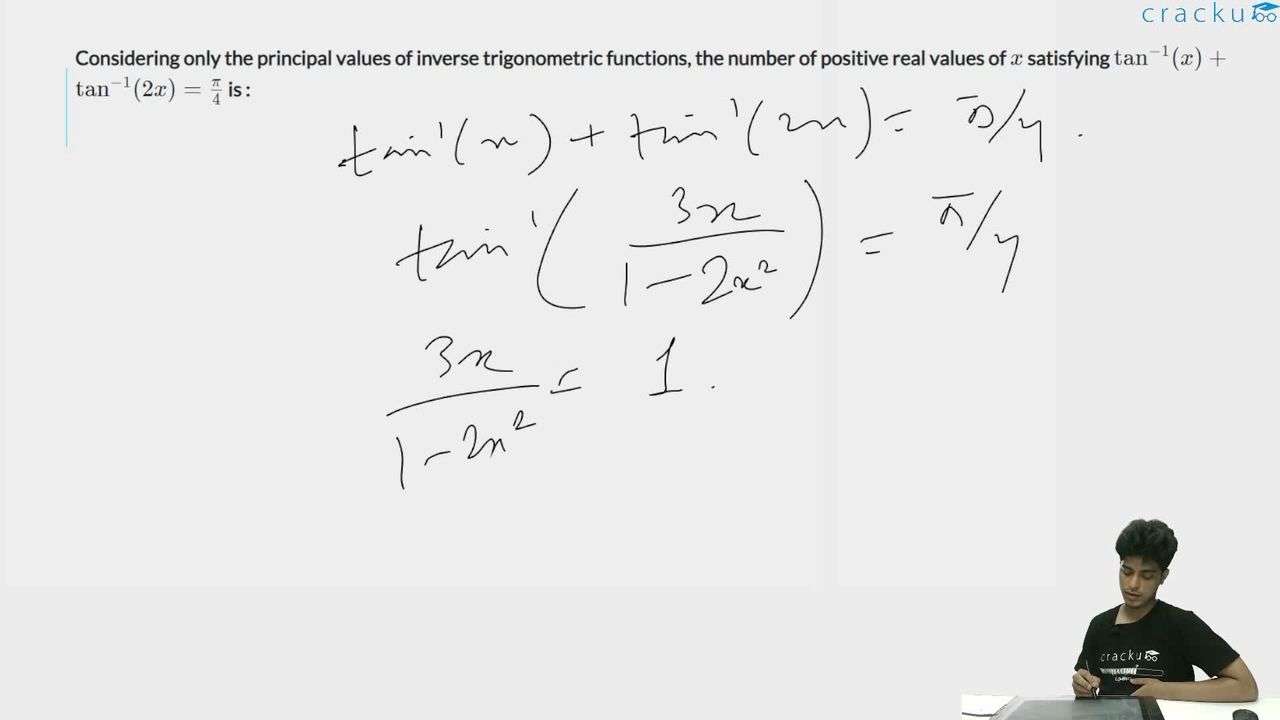
Considering only the principal values of inverse trigonometric functions, the number of positive real values of $$x$$ satisfying $$\tan^{-1}(x) + \tan^{-1}(2x) = \frac{\pi}{4}$$ is :
Apply the formula $$\tan^{-1} A + \tan^{-1} B = \tan^{-1}(\frac{A+B}{1-AB})$$:
$$\tan^{-1}\left(\frac{x + 2x}{1 - x(2x)}\right) = \frac{\pi}{4} \implies \frac{3x}{1 - 2x^2} = \tan(\frac{\pi}{4}) = 1$$
$$3x = 1 - 2x^2 \implies 2x^2 + 3x - 1 = 0$$
Using the quadratic formula $$x = \frac{-b \pm \sqrt{b^2 - 4ac}}{2a}$$:
$$x = \frac{-3 \pm \sqrt{9 - 4(2)(-1)}}{4} = \frac{-3 \pm \sqrt{17}}{4}$$
Since the question asks for positive real values:
$$x = \frac{-3 + \sqrt{17}}{4}$$ (This is positive because $$\sqrt{17} > 3$$)
The other value is negative. Thus, there is only 1 positive solution
Was this solution helpful?
Click on the Email ☝️ to Watch the Video Solution
Create a FREE account and get:
_1.webp)

Educational materials for JEE preparation

Ask our AI anything

AI can make mistakes. Please verify important information.
AI can make mistakes. Please verify important information.
