
Join Our JEE Preparation Group
Prep with like-minded aspirants; Get access to free daily tests and study material.
Sign in
Please select an account to continue using cracku.in
↓ →
Join Our JEE Preparation Group
Prep with like-minded aspirants; Get access to free daily tests and study material.
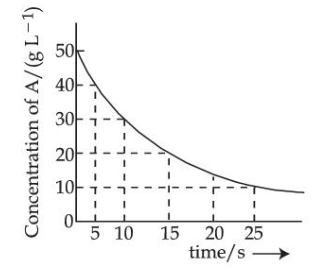
For the reaction $$A \to B$$ the following graph was obtained. The time required (in seconds) for the concentration of A to reduce to 2.5 g L$$^{-1}$$ (if the initial concentration of A was 50 g L$$^{-1}$$) is _________.
(Nearest integer)
Given : $$\log 2 = 0.3010$$
Correct Answer: 43
By analyzing the given concentration versus time graph, we observe that:
Since the concentration decreases from $$50,\text{g L}^{-1}$$ to $$25,\text{g L}^{-1}$$ in $$10,\text{s}$$, the half-life of the reaction is
$$t_{1/2} = 10,\text{s}.$$
A constant half-life is characteristic of a first-order reaction.
For a first-order reaction,
$$t=\frac{2.303}{k}\log\left(\frac{[A]_0}{[A]}\right).$$
The relationship between the rate constant and half-life is
$$k=\frac{2.303\log 2}{t_{1/2}}.$$
Substituting this expression for $$k$$ into the integrated rate equation,
$$t=\frac{t_{1/2}}{\log 2}\log\left(\frac{[A]_0}{[A]}\right).$$
Using the given data,
we get
$$t=\frac{10}{0.3010}\log\left(\frac{50}{2.5}\right).$$
Since
$$\frac{50}{2.5}=20,$$
the equation becomes
$$t=\frac{10}{0.3010}\log(20).$$
Using the logarithmic identity,
$$\log(20)=\log(2\times10)=\log2+\log10=0.3010+1=1.3010,$$
we obtain
$$t=\frac{10}{0.3010}\times1.3010,$$
$$t=\frac{13.010}{0.3010}\approx43.22,\text{s}.$$
Rounding to the nearest integer,
$$\boxed{43}$$
Hence, the required time is
$$\boxed{43\ \text{s}}.$$
Was this solution helpful?
Create a FREE account and get:
_1.webp)

Educational materials for JEE preparation

Ask our AI anything

AI can make mistakes. Please verify important information.
AI can make mistakes. Please verify important information.


