
Join Our JEE Preparation Group
Prep with like-minded aspirants; Get access to free daily tests and study material.
Sign in
Please select an account to continue using cracku.in
↓ →
Join Our JEE Preparation Group
Prep with like-minded aspirants; Get access to free daily tests and study material.
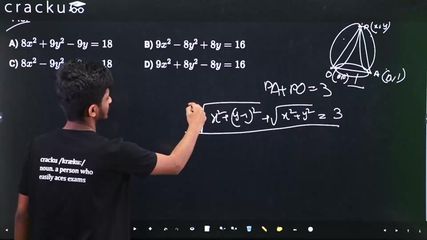
Let $$O(0,0)$$ and $$A(0,1)$$ be two fixed points. Then, the locus of a point P such that the perimeter of $$\triangle AOP$$ is 4 is:
We let the moving point be $$P(x,y)$$. The fixed points are $$O(0,0)$$ and $$A(0,1)$$. The condition given is that the perimeter of $$\triangle AOP$$ is $$4$$.
By the distance formula, the length of a segment whose end-points are $$(x_1,y_1)$$ and $$(x_2,y_2)$$ equals $$\sqrt{(x_2-x_1)^2+(y_2-y_1)^2}$$. Using this formula one by one we obtain
$$OA=\sqrt{(0-0)^2+(1-0)^2}=1,$$
$$OP=\sqrt{(x-0)^2+(y-0)^2}=\sqrt{x^{2}+y^{2}},$$
$$AP=\sqrt{(x-0)^2+(y-1)^2}=\sqrt{x^{2}+(y-1)^{2}}.$$
The perimeter condition therefore reads
$$OA+OP+AP=4 \;\;\Longrightarrow\;\; 1+\sqrt{x^{2}+y^{2}}+\sqrt{x^{2}+(y-1)^{2}}=4.$$
Subtracting $$1$$ from both sides gives
$$\sqrt{x^{2}+y^{2}}+\sqrt{x^{2}+(y-1)^{2}}=3.$$
We now remove the square-roots step by step. First we square once:
$$\bigl(\sqrt{x^{2}+y^{2}}+\sqrt{x^{2}+(y-1)^{2}}\bigr)^{2}=9.$$
Using $$(a+b)^{2}=a^{2}+2ab+b^{2},$$ we get
$$x^{2}+y^{2}+2\sqrt{(x^{2}+y^{2})\bigl(x^{2}+(y-1)^{2}\bigr)}+x^{2}+(y-1)^{2}=9.$$
Combining the like terms inside the radical first:
$$(y-1)^{2}=y^{2}-2y+1,$$
so the non-radical part becomes
$$2x^{2}+y^{2}+y^{2}-2y+1 = 2x^{2}+2y^{2}-2y+1.$$
Hence the equation is
$$2x^{2}+2y^{2}-2y+1+2\sqrt{(x^{2}+y^{2})\bigl(x^{2}+y^{2}-2y+1\bigr)}=9.$$
Isolating the radical term:
$$2\sqrt{(x^{2}+y^{2})\bigl(x^{2}+y^{2}-2y+1\bigr)}=9-\bigl(2x^{2}+2y^{2}-2y+1\bigr).$$
Simplifying the right side:
$$9-(2x^{2}+2y^{2}-2y+1)=8-2x^{2}-2y^{2}+2y.$$
Dividing by $$2$$ gives
$$\sqrt{(x^{2}+y^{2})\bigl(x^{2}+y^{2}-2y+1\bigr)}=4-x^{2}-y^{2}+y.$$
We square a second time to eliminate the remaining root:
$$(x^{2}+y^{2})\bigl(x^{2}+y^{2}-2y+1\bigr)=\bigl(4-x^{2}-y^{2}+y\bigr)^{2}.$$
For convenience set $$A=x^{2}+y^{2}$$. Then the left side becomes
$$A(A-2y+1)=A^{2}-2yA+A.$$
Expanding back in terms of $$x$$ and $$y$$ we obtain
$$x^{4}+2x^{2}y^{2}+y^{4}-2x^{2}y-2y^{3}+x^{2}+y^{2}.$$
Now we expand the right side. Write $$B=4-x^{2}-y^{2}+y$$ and use $$(a+b+c+d)^{2}=a^{2}+b^{2}+c^{2}+d^{2}+2(ab+ac+ad+bc+bd+cd).$$ With $$a=4,\; b=-x^{2},\; c=-y^{2},\; d=y$$ we get
$$\bigl(4-x^{2}-y^{2}+y\bigr)^{2}=16+x^{4}+y^{4}+y^{2}-8x^{2}-8y^{2}+8y+2x^{2}y^{2}-2x^{2}y-2y^{3}.$$
Equating the left and right expansions and cancelling the common terms $$x^{4},\; 2x^{2}y^{2},\; y^{4},\; -2x^{2}y,\; -2y^{3}$$ gives the simpler relation
$$-8x^{2}-7y^{2}+8y+16-x^{2}-y^{2}=0.$$
Combining like terms leads to
$$-9x^{2}-8y^{2}+8y+16=0.$$
Multiplying by $$-1$$ (which does not change the locus) puts it in the customary form
$$9x^{2}+8y^{2}-8y-16=0.$$
Finally, moving the constant term to the right side we have
$$9x^{2}+8y^{2}-8y=16.$$
This equation exactly matches the expression given in Option D:
$$9x^{2}+8y^{2}-8y=16.$$
Hence, the correct answer is Option D.
Was this solution helpful?
Click on the Email ☝️ to Watch the Video Solution
Create a FREE account and get:
_1.webp)

Educational materials for JEE preparation

Ask our AI anything

AI can make mistakes. Please verify important information.
AI can make mistakes. Please verify important information.
