
Join Our JEE Preparation Group
Prep with like-minded aspirants; Get access to free daily tests and study material.
Sign in
Please select an account to continue using cracku.in
↓ →
Join Our JEE Preparation Group
Prep with like-minded aspirants; Get access to free daily tests and study material.
The sum of the squares of the lengths of the chords intercepted on the circle, $$x^{2} + y^{2} = 16$$, by the lines, $$x + y = n$$, $$n \in N$$, where N is the set of all natural numbers is:
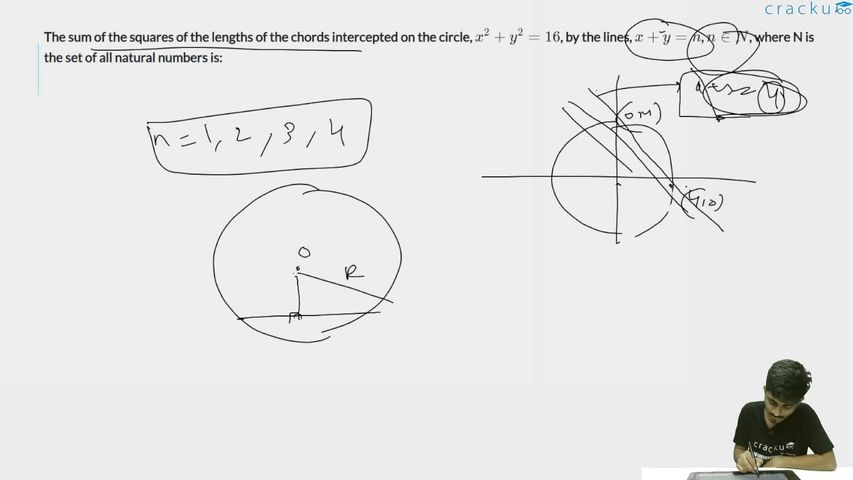
We have the circle $$x^{2}+y^{2}=16$$ whose centre is clearly at the origin $$O(0,0)$$ and whose radius is $$R=4$$ because, in the general form $$x^{2}+y^{2}=R^{2}$$, the constant term is the square of the radius.
For every natural number $$n \in \mathbb N$$ we consider the straight line $$x+y=n$$. A straight line intersects the circle and gives a real chord only when the perpendicular distance of that line from the centre is not greater than the radius.
The perpendicular distance $$d$$ of the line $$x+y=n$$ from the origin is obtained from the distance formula
$$ d=\frac{|\,Ax_{0}+By_{0}+C\,|}{\sqrt{A^{2}+B^{2}}} $$
where $$A=1,\;B=1,\;C=-n$$ and $$\bigl(x_{0},y_{0}\bigr)=(0,0)$$. Substituting we get
$$ d=\frac{|\,0+0-n\,|}{\sqrt{1^{2}+1^{2}}}=\frac{n}{\sqrt{2}}. $$
For the line to cut the circle we need $$d\le R$$, that is
$$ \frac{n}{\sqrt{2}}\;\le\;4 \;\;\Longrightarrow\;\; n\le4\sqrt2\approx5.657. $$
Since $$n$$ must be a natural number, the admissible values are
$$ n=1,\,2,\,3,\,4,\,5. $$
Thus we have exactly five chords to consider.
Now, for a circle of radius $$R$$ and a chord at a perpendicular distance $$d$$ from the centre, the length $$\ell$$ of the chord is given by the standard formula
$$ \ell = 2\sqrt{R^{2}-d^{2}}. $$
Stating the formula first and then substituting, we put $$R=4$$ and $$d=\dfrac{n}{\sqrt{2}}$$ to obtain
$$\ell_{n}=2\sqrt{\,16-\left(\frac{n}{\sqrt{2}}\right)^{2}} =2\sqrt{\,16-\frac{n^{2}}{2}}.$$
We are asked for the sum of the squares of these lengths, so we square the above expression before adding. Squaring gives
$$\ell_{n}^{2} =\bigl(2\bigr)^{2}\Bigl(16-\frac{n^{2}}{2}\Bigr) =4\left(16-\frac{n^{2}}{2}\right) =64-2n^{2}.$$
Hence, for each natural number $$n$$ in the set $$\{1,2,3,4,5\}$$, the square of the chord length is $$64-2n^{2}$$. We sum all these values:
$$\begin{aligned} \sum_{n=1}^{5}\ell_{n}^{2} &=\sum_{n=1}^{5}\bigl(64-2n^{2}\bigr) \\ &=64+64+64+64+64 \;-\;2\bigl(1^{2}+2^{2}+3^{2}+4^{2}+5^{2}\bigr) \\ &=5\times64 \;-\;2\bigl(1+4+9+16+25\bigr) \\ &=320 \;-\;2\times55 \\ &=320-110 \\ &=210. \end{aligned}$$
Therefore the required sum is $$210$$. Numerically this matches option A.
Hence, the correct answer is Option A.
Was this solution helpful?
Click on the Email ☝️ to Watch the Video Solution
Create a FREE account and get:
_1.webp)

Educational materials for JEE preparation

Ask our AI anything

AI can make mistakes. Please verify important information.
AI can make mistakes. Please verify important information.
